Is Jiufen Worth Visiting?
An honest yes-with-conditions answer to whether Jiufen is worth visiting, built on verified rain normals, the weekend traffic control plan, real visitor numbers and the corrected Ghibli story.
Is Jiufen Worth Visiting?
Yes, Jiufen is worth visiting, provided you accept four documented conditions: it rains on 193.6 days a year at the nearest weather station, coach access is rationed on weekends and holidays, the scenic area took 3,769,615 visitors in two months of 2026, and the Ghibli connection is false. What survives is a mining town on a hillside with a sea view and a teahouse culture, reachable from Taipei for NT$73.
That is the whole answer in one paragraph, and every number in it comes from an official source. The rest of this article unpacks each condition, because the conditions are not caveats bolted on for honesty's sake. They are the difference between a day you remember and a day you spend queuing in drizzle.
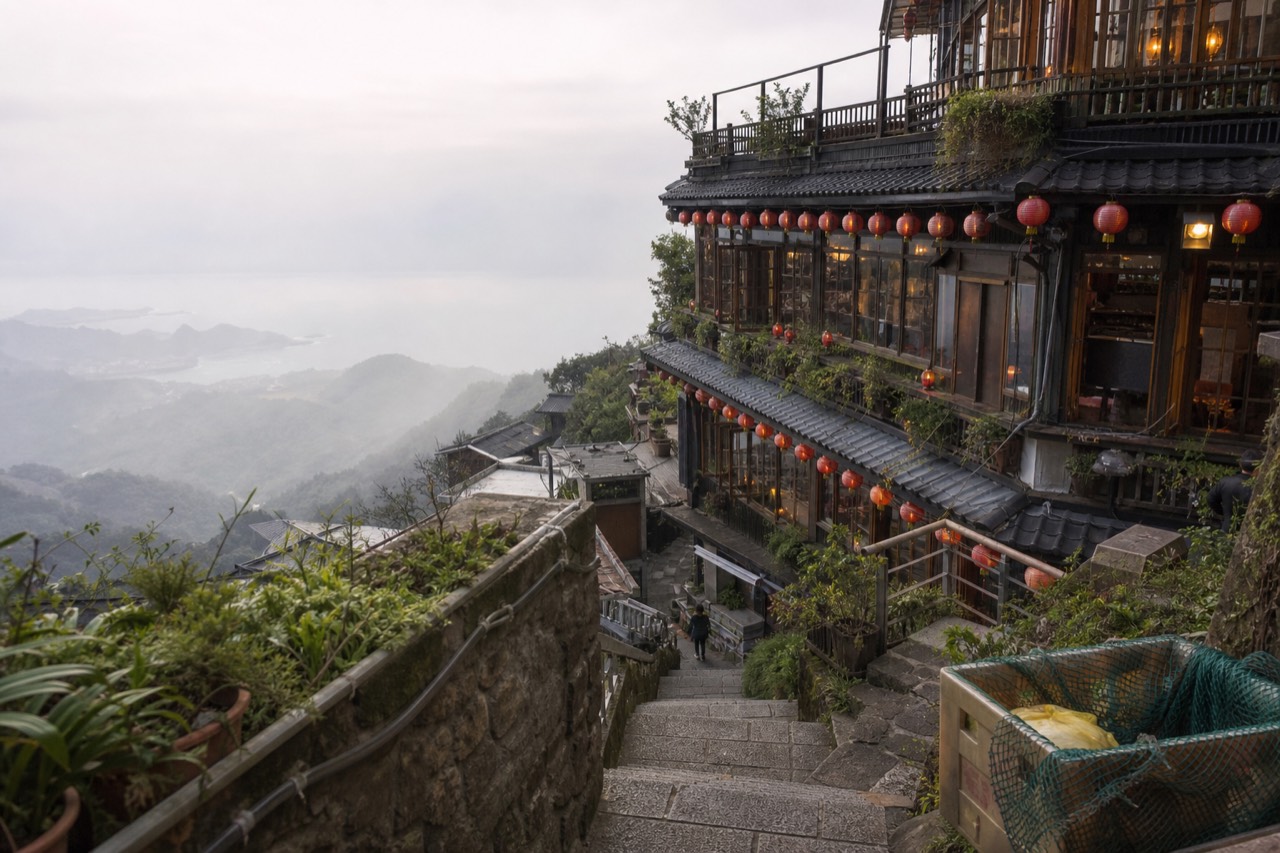
Start with the frame most visitors miss. Jiufen is not a theme park and never was. It is a former gold-rush town on Taiwan's northeast coast where, in 1890, someone struck gold and a poor village of 4,000 prospecting families became known as little Shanghai, according to the Taiwan Tourism Administration's own page for the town. The gold is gone. The hillside, the steps, the lanterns and the teahouses stayed.
The name itself is better documented than the tourist version suggests. The familiar story is that nine households lived here and supplies landed from the coast had to be divided into nine portions. New Taipei City's own 2016 release calls that a legend, and both the city and the national tourism body give a different origin: before the gold, the area lived by harvesting and boiling camphor, with 90 camphor stoves, and ten stoves made one "fen", so there were nine. The Tourism Administration's English page never mentions nine families at all. The English internet has this story backwards, and knowing it changes nothing about the view.
The four conditions deserve a table before anything else, because each one has a number behind it and each number has a source.
| Condition | The documented figure | What it means for your day |
|---|---|---|
| Rain | 193.6 rain days a year at Keelung, the nearest station | It rains on more than half of all days; pack for it |
| Weekend access control | 08:00 to 20:00 on weekends and holidays, coaches rationed to roughly 40 a day | Trains and weekdays beat coaches on Saturdays |
| Crowds | 3,769,615 visitors to the Ruifang scenic area in Jan to Feb 2026 | Third most-visited spot in New Taipei City |
| The Ghibli story | Denied on the record by Studio Ghibli's producer | Go for the town, not for the film claim |
If those four rows look manageable, and they are, the answer stays yes. If any one of them is a dealbreaker, this article will tell you which alternative to read instead. For combining the town with the rest of the northeast coast in one day, these are the three options worth a look first.
Is Jiufen Worth Going?
Yes, and the getting there is better documented than most of what is written about it. Taipei Main Station to Ruifang has 45 to 47 direct trains a day, the journey runs 32 to 68 minutes with a median of 46, and the local train costs NT$73. On this route the express saves about 13 minutes over the median local and costs NT$41 more, so the local is the sensible default.
That frequency matters more than any coach itinerary. There is no direct train from Taipei to Shifen, zero services, so every rail-based day changes at Ruifang, and the Pingxi branch then runs 17 direct trains a day to Shifen at a flat NT$29. The branch runs the identical 17 trains on a Saturday as on a Monday. The line gets no extra weekend capacity, which is worth knowing before you plan a Saturday lantern release around a train that does not exist.
The branch timetable has two gaps that catch people out. After the 16:54 departure from Ruifang the next train to Shifen is not until 18:33, a wait of 1h39m, and after the 19:22 the next is 21:06, a wait of 1h44m. Roughly hourly through the middle of the day, then thin. If your plan involves a late-afternoon lantern release and a train home, read those two gaps before you commit, because they are the difference between a relaxed evening and an unplanned hour in a small station.
| Train class, Taipei to Ruifang | Full fare | Concession |
|---|---|---|
| Local and Fast Local | NT$73 | NT$37 |
| Chu-Kuang | NT$87 | NT$44 |
| Tze-Chiang and Puyuma | NT$114 | NT$57 |
The road option has a catch almost no English page carries. Under a signed New Taipei City Government notice in force since 1 January 2025, Jiufen is a managed-access destination between 08:00 and 20:00 on every weekend, national holiday, Labour Day and make-up working day. Coaches must apply in advance to Ruifang Police Precinct, are split into morning and afternoon slots of roughly 20 coaches each, and may not drive to Jiufen Old Street on their own. Applications are refused entirely during holiday runs of three or more consecutive days. The plan restricts coaches, not private cars and never pedestrians, but the practical effect is the same for a tour-bus day: on a long weekend your coach may be dropping you at a car park to transfer to a shuttle.
Coaches that miss out on a slot drop passengers at New No. 9 car park, free if the vehicle leaves within 20 minutes, or at Shuinandong, and passengers transfer to a Keelung Bus shuttle into Jiufen. The stretch from Jiufen Police Station to the Quanjitang car park at Jinguashi is officially designated a dangerous, accident-prone section because two vehicles cannot easily pass, and large coaches are barred from it except shuttles and scheduled services. None of this is secret. It is a signed public notice, served on the bus operators, the travel agents' associations and the Jiufen business district association, and almost nothing in English carries it.
That is a real argument for the train, and a real argument for going on a weekday. A fuller breakdown of routes and timetables is in the Taipei to Jiufen transport guide.
Is Jiufen Really Worth Visiting?
Yes, but not for the reason most visitors cite. Studio Ghibli producer Toshio Suzuki denied on the record on 19 September 2023 that Jiufen inspired Spirited Away, saying neither he nor Miyazaki has ever been to Jiufen, and attributing the moment of resemblance Miyazaki actually had to an alley in Seoul. The resemblance a visitor sees in Jiufen is real. Only the causal claim is false.
This is the single most repeated claim in English about Jiufen, and it is false as usually stated. Suzuki was interviewed in Tokyo by Taiwanese media during promotion for The Boy and the Heron, and his denial was published by ETtoday on 19 September 2023, with Mirror Media and FTNN reporting the same quotes within a day. FTNN's own headline framed the story as ending a 22-year misunderstanding. Suzuki added that the rumour does not trouble him, because it means people care about the work.
So strip the film out of the decision. What is left? A hillside town of steps and lanterns that the national tourism body describes as next to the mountain and facing the sea, a place where the gold rush of 1890 drew 4,000 prospecting families and the nickname little Shanghai. The view, the fog and the teahouse culture are not diminished by the denial. They simply belong to Jiufen rather than to a film, and the town earns its visit on its own record. The full story, including what Suzuki said about Seoul, is in the Spirited Away claim examined.
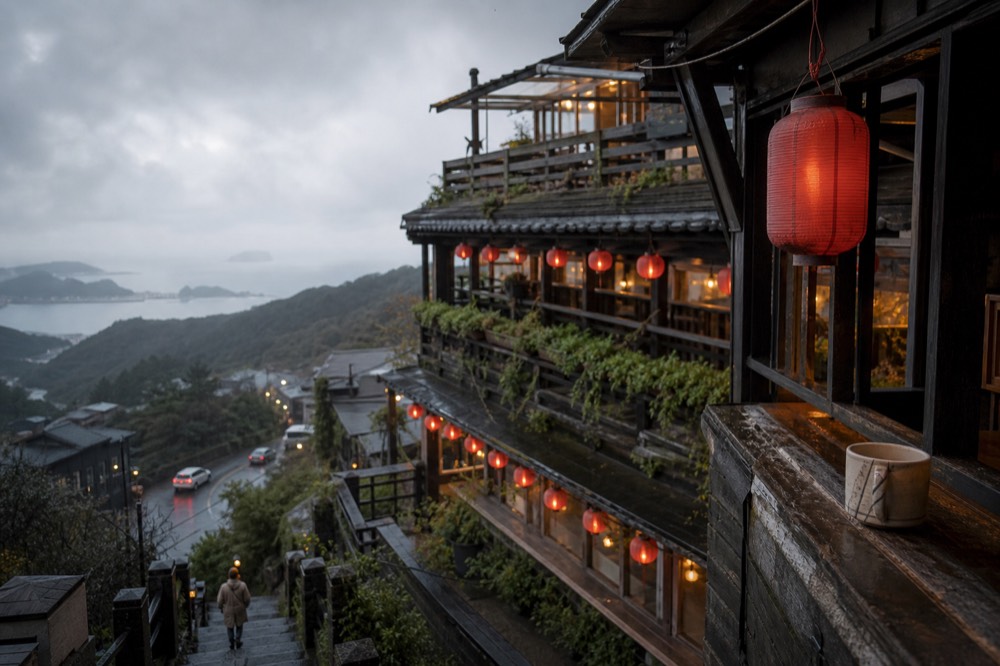
There is a practical consequence to the denial worth spelling out. No teahouse in Jiufen can honestly be called "the Spirited Away teahouse", A-Mei Tea House included, because the association is marketing, not provenance. If a shop or a tour leans on the film as its pitch, treat that as a signal about the pitch, not about the building. The buildings, the tea and the view stand on their own, and they are the reason to book a table.
If the Ghibli claim was your only reason for going, the honest move is to re-decide on the town's own merits, and on those merits the answer is still yes. The one product built for visitors who want only Jiufen, with no coast stops, is the in-depth half-day tour of the old street, rated 4.9 across 267 reviews and free to cancel.
Is Jiufen Old Street Worth Visiting?
Yes, the old street is the reason to come, and it costs less than the internet implies. Admission to the street is free, the verified teahouse floor for two people sharing the cheapest pot at A-Mei Tea House is NT$700 before food, and the Gold Museum up the road at Jinguashi is NT$80. The street itself is a set of three named lanes whose names explain the town's layout.
Those names are official, from a New Taipei City Government release of 6 January 2016. Jishan Street means the street that connects to the foot of Keelung Mountain. Shuqi Road means the road of many vertical steps. Qingbian Road, the quiet flat lane parallel to the main street, is the trackbed of a human-powered light railway laid in 1931, which is exactly why it is flat while Shuqi Road is a staircase. Almost no English page carries that, and it changes how you walk the town: the flat lane exists because it used to be a railway.
The same release carries one more detail that rewards a slower walk. The Jiufen mine had ten numbered tunnels running down the hill, and only Nos. 5, 8 and 10 still have intact portal exteriors. Two bus stops nearby still carry the old pit names. It is a small thing, but it is the difference between a street you photograph and a town you can read.
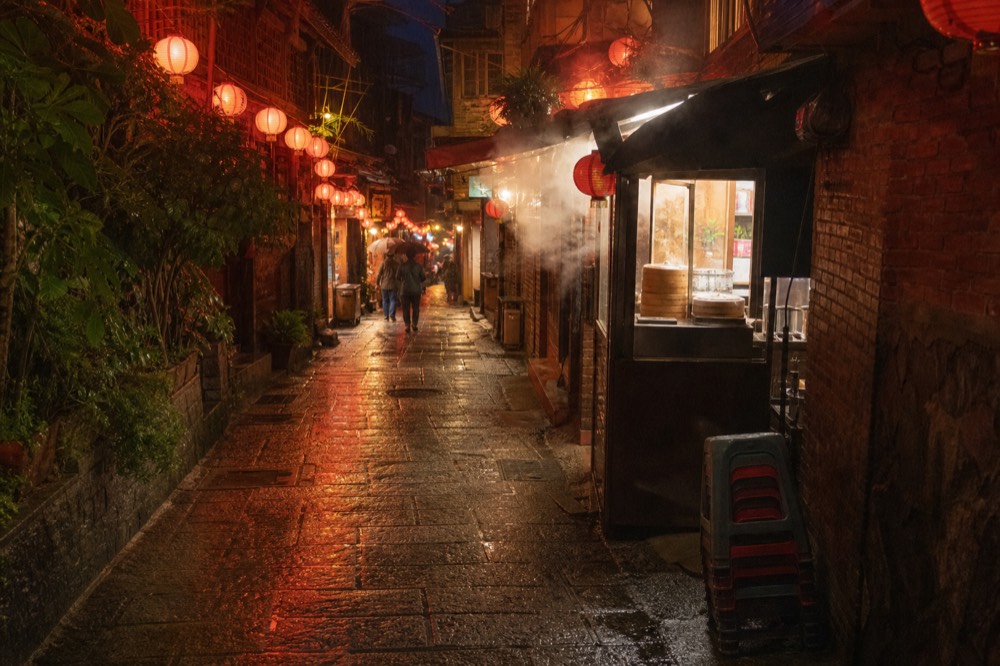
The teahouse arithmetic is where visitors get caught. A-Mei Tea House, the only teahouse in Jiufen whose prices are verified from its own menu, charges a tea water fee of NT$100 per person before anything else. The cheapest pot of leaves is NT$500. So two people sharing that pot pay NT$100 plus NT$100 plus NT$500, which is NT$700 before any food, and the full menu is published on the venue's own site. Set meals run NT$300 to NT$350 and are served 10:30 to 13:30 only. Parties of six or more must order two portions of leaves. None of this is a rip-off. It is simply the real floor, and English blogs that quote only the NT$100 fee are quoting a quarter of it.
| Item | Verified price | Source |
|---|---|---|
| Jiufen Old Street admission | Free | No ticket exists for the street |
| A-Mei Tea House, two people, cheapest pot | NT$700 total | Venue's own menu |
| Gold Museum, Jinguashi | NT$80 per person | Museum's own ticket page |
| Yehliu Geopark, if you extend the day | NT$120 adult | Park's own ticket page |
| Train, Taipei to Ruifang | NT$73 local | TRA fare tables |
Up the hill at Jinguashi, the Gold Museum charges NT$80, takes cash, EasyCard and O'Pay, and is closed the first Monday of every month. If that Monday is a national holiday the museum opens and closes the following day instead. It is also closed Lunar New Year's Eve and the first day of Lunar New Year. That first-Monday closure is the single most useful practical fact about Jinguashi and it is routinely missing from English pages. The museum's own pages carry the full admission and hours detail in English.
For a first visit that keeps the focus on the street itself, the Jiufen In-depth Half-Day Tour is the only product on this site that goes to Jiufen and nowhere else. It departs from Taipei Main Station in the morning or afternoon, is rated 4.9 across 267 reviews, costs from $26.55 per person, and confirms free cancellation.
When The Answer Is No
Jiufen stops being worth it in two documented situations: in the wettest months, when the northeast monsoon delivers 61% of the year's rain across September to February, and on long weekends, when coach applications are refused entirely and the street carries holiday crowds. December offers 48.5 sunshine hours in the whole month, about 1.6 hours a day. Pick a different month or a weekday and the verdict flips back to yes.
The rain data is not folklore. It is the Central Weather Administration's 30-year normals for 1991 to 2020, and the correct station to cite is Keelung, about 12 km away on the same windward coast, because there is no CWA station at Jiufen itself. Keelung records 3,589.7 mm a year against Taipei's 2,329.5 mm, about 54% more rain, over stations roughly 25 km apart. It rains on 193.6 days a year, more than half of all days, against Taipei's 163.3. The full normals are published by the CWA. The pattern inverts the usual advice about avoiding Taiwan in summer: July is the driest month on this coast, at 119.5 mm across 8.5 rain days.
| Month | Rainfall | Rain days | Read |
|---|---|---|---|
| July | 119.5 mm | 8.5 | Driest month of the year |
| August | 211.4 mm | 11.6 | Second driest |
| October | 377.6 mm | 17.1 | Monsoon building |
| November | 396.9 mm | 18.6 | Wettest month |
| December | 356.6 mm | 19.5 | 48.5 sunshine hours all month |
The other no-case is the long weekend. The traffic control plan refuses coach applications entirely during holiday runs of three or more consecutive days, so a coach day tour on those dates is a fragile plan before you even consider the crowds. A weekday visit by train sidesteps both problems at once, and the best time to visit guide works through the whole calendar.
One more honest note on crowds. The Tourism Administration counts the Ruifang scenic area, never the street, so never read a figure of 3,769,615 as the street's own attendance. What the number does prove is that this corner of New Taipei is one of the most visited places in the city's statistics, and that timing your day matters more here than almost anywhere else in Taiwan. Visitors report the street as calm before about 09:00 and after about 19:00, with the heaviest crowding mid-afternoon on weekends; that is the pattern people describe, not an official schedule, and no official shop hours exist.
If you decide the full coast circuit is the better use of a dry-weather day, the pineapple cake DIY tour is the version that breaks up the coach time with a baking stop. It runs 9h45 through Yehliu Geopark, Jiufen Old Street and Shifen Old Street, is rated 4.8 across 6,260 reviews, and costs from $24.45 per person with tickets included.
Whichever way you decide, decide on the documented record rather than the postcard version. A town that is wet more than half the year, rationed on weekends and misattributed to a film for two decades is still a town worth a day, and Jiufen Tour exists to make that case with numbers you can check.
The short answers to the questions visitors ask most about Jiufen, each one resting on a documented figure: the train fare, the rain normals, the traffic control plan, the visitor statistics and the on-the-record Ghibli denial. Every number below can be traced to an official source, and none of it is guesswork.
Common Questions About Jiufen
Is Jiufen Worth Visiting?
Yes, with four documented conditions: 193.6 rain days a year at the nearest weather station, managed access between 08:00 and 20:00 on weekends and holidays, 3,769,615 visitors to the Ruifang scenic area in January and February 2026, and a Studio Ghibli connection that has been denied on the record. A mining town with a sea view, a teahouse culture and a NT$73 train from Taipei survives all four.
Is Jiufen worth going?
Yes, and the train is the best-documented way: 45 to 47 direct services a day from Taipei Main Station to Ruifang, 32 to 68 minutes, NT$73 on the local. On weekends the traffic control plan makes the coach alternative fragile, and on holidays of three or more consecutive days coach applications are refused entirely.
Is jiufen really worth visiting?
Yes, but not because of Spirited Away. Studio Ghibli producer Toshio Suzuki denied that connection on 19 September 2023, saying neither he nor Miyazaki has ever been to Jiufen. The town earns its visit on its own record: an 1890 gold rush, a hillside of steps and lanterns, and verified teahouse culture.
Is Jiufen Old Street worth visiting?
Yes, and it is free to walk. The verified cost floor is the teahouse: two people sharing the cheapest pot at A-Mei Tea House pay NT$700 before food. The street is three named lanes, including a flat lane that is the trackbed of a 1931 light railway, which explains why one lane is level and the other is a staircase.
When is Jiufen not worth visiting?
In the wettest stretch of the northeast monsoon, September to February, which carries 61% of the year's rain, and on long weekends, when coach access is switched off entirely and holiday crowds peak. December offers 48.5 sunshine hours in the whole month. July is the driest month, and weekdays beat weekends for access.
How do I get to Jiufen from Taipei?
Take the train from Taipei Main Station to Ruifang, NT$73 on the local, then a bus up the hill. There is no direct train from Taipei to Shifen, so any rail day that adds Shifen changes at Ruifang onto the Pingxi branch, a flat NT$29, running 17 trains a day.