Jiufen Weather: The Best Time To Visit, Backed By Real Climate Data
The standard advice about when to visit Taiwan is wrong for Jiufen. The nearest weather station's own 30-year numbers say the driest month is July, the wettest is November, and the biggest factor in your visit may not be rain at all.
Short answer
The driest month on Jiufen's nearest coast is July, with 119.5 mm of rain across 8.5 rain days, per 30-year CWA normals for Keelung. The wettest is November at 396.9 mm. Weekdays beat weekends for a second reason: coach access to Jiufen is rationed on weekends and holidays from 08:00 to 20:00.
The standard line in English travel content is to avoid Taiwan in summer. For Jiufen, the numbers say the opposite. The nearest official weather station, Keelung on the same windward north coast, records its driest month of the year in July: 119.5 mm of rain across just 8.5 rain days, against 396.9 mm and 18.6 rain days in November. Those are Central Weather Administration 30-year normals, the hardest weather data that exists for this corner of the island, and almost no English page quotes them.
This guide on Jiufen Tour builds the whole month-by-month picture from that dataset, explains the one honest caveat (there is no station in Jiufen itself), and adds the factor that matters as much as rain: on weekends and holidays, Jiufen is a managed-access destination under a signed New Taipei City traffic control plan that rations coach access between 08:00 and 20:00.
What Is The Weather Actually Like In Jiufen?
Jiufen sits on Taiwan's northeast coast, and the honest numbers come from Keelung, the nearest official weather station about 12 km away, which records 3,589.7 mm of rain a year across 193.6 rain days, about 54 percent more than Taipei and rain on more than half of all days. No station exists in Jiufen itself, so every figure here is a Keelung figure, and the pattern, not the totals, is what transfers up the hill.
That caveat matters, so it comes first. The Central Weather Administration (CWA) has no station at Jiufen. The nearest manned station is Keelung, number 466940, on the same coast facing the same northeast monsoon, and its 30-year normals for 1991 to 2020 are the correct source. Jiufen sits higher and further inland, so the reasonable statement is that the pattern holds and is probably wetter up the hill, but no number should be put on that difference.
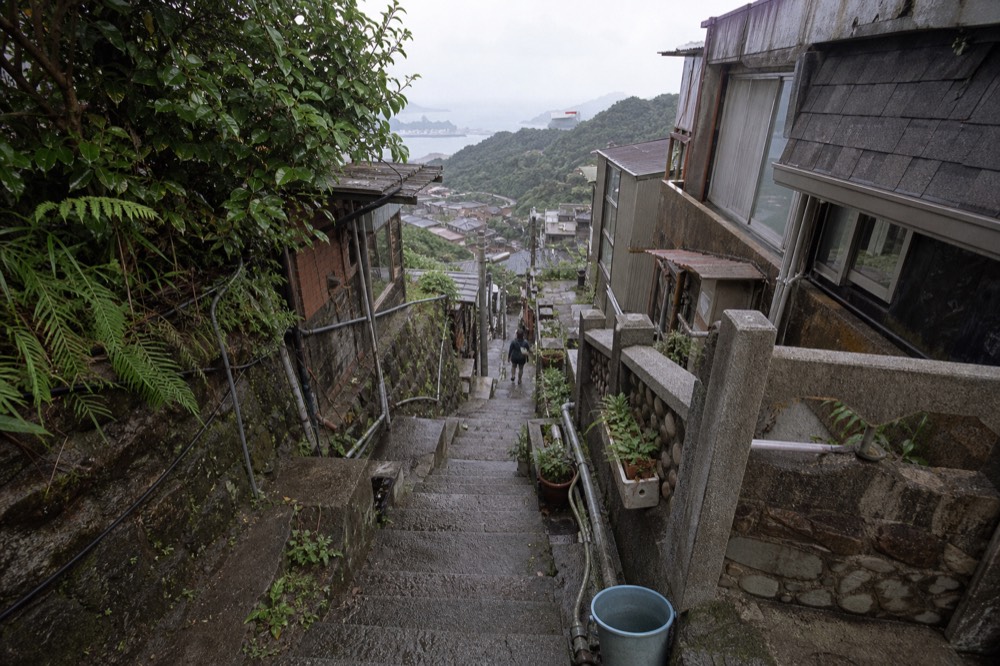
The comparison with Taipei is the part that surprises people. Two stations about 25 km apart, on paper in the same metro region, record wildly different weather. Keelung takes 3,589.7 mm a year against Taipei's 2,329.5 mm, a gap of 1,260 mm, or about 54 percent more. It rains on 193.6 days a year at Keelung versus 163.3 in Taipei. A visitor who checks a Taipei forecast before heading to Jiufen is checking the wrong coast.
| Measure | Keelung station 466940 | Taipei station 466920 |
|---|---|---|
| Annual rainfall | 3,589.7 mm | 2,329.5 mm |
| Annual rain days | 193.6 | 163.3 |
| Annual sunshine hours | 1,316.9 | 1,382.9 |
| Mean annual temperature | 22.8 °C | 23.3 °C |
| Mean relative humidity | 76.6% | not compared here |
| Driest month | July, 119.5 mm | July, 226.1 mm |
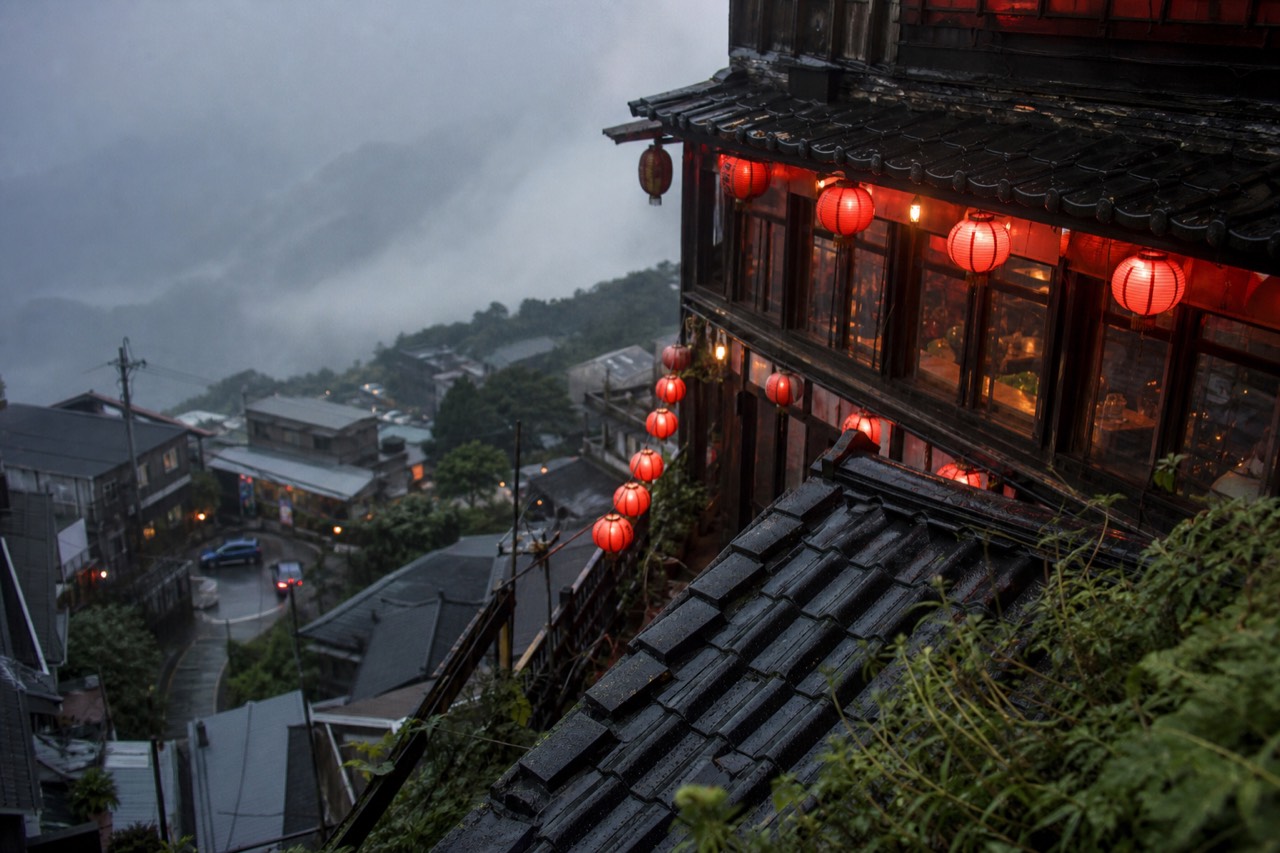
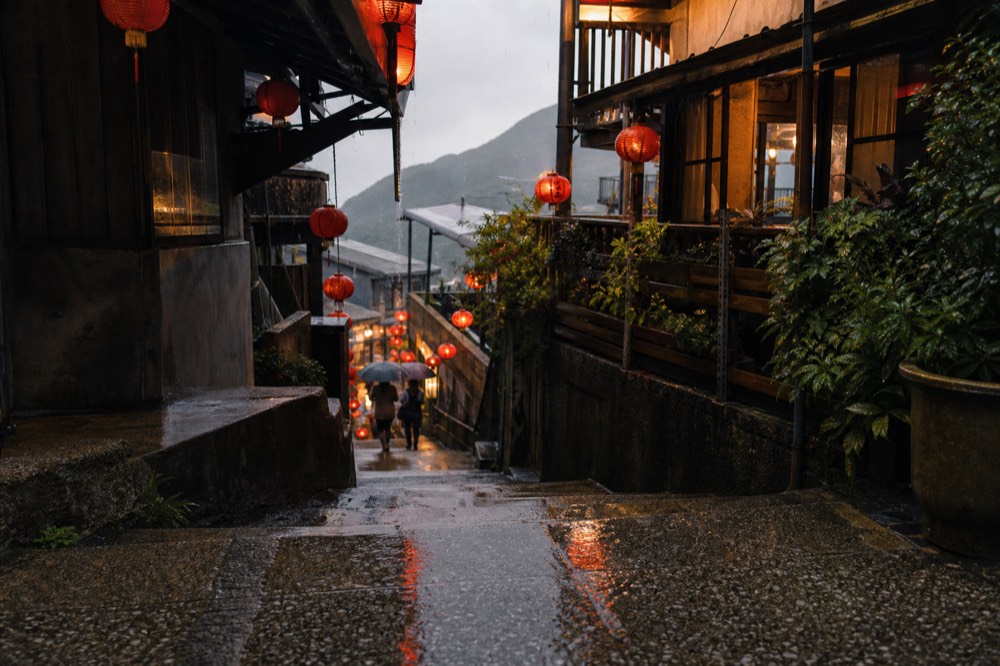
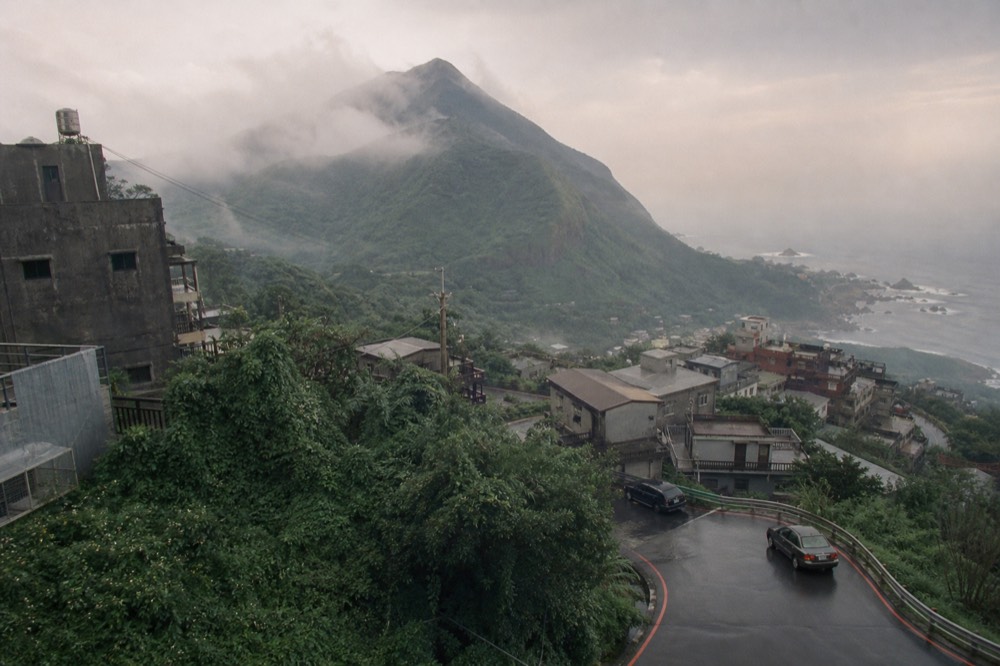
The reason is geography. The northeast monsoon, which dominates from autumn through spring, pushes moist air off the East China Sea straight into this coast, and the mountains rise immediately behind it. The result is the fog and drizzle Jiufen is famous for, not tropical downpours. The town's moody, lantern-lit-in-mist reputation is a direct product of this climate, which cuts both ways: the same weather that soaks a November visit is what makes the photographs look the way they do.
The CWA publishes these normals directly, and the full station tables can be read at the CWA climate statistics page.
Which Month Is The Driest For Visiting Jiufen?
July is the driest month on the Keelung normals at 119.5 mm of rain and 8.5 rain days, which inverts the usual avoid-Taiwan-in-summer advice for this coast; August is second at 211.4 mm and 11.6 rain days, and April is the best shoulder-season pick at 211.1 mm and 16.0 rain days, while November is the wettest month of the year at 396.9 mm.
The month table below is the heart of this guide, built straight off the 1991 to 2020 normals. Read the rainfall and rain-day columns together: a month can be moderately wet in total but pleasant if the rain comes in short bursts, and the rain-day count is the better guide to how a visit actually feels.
| Month | Rainfall (mm) | Rain days | Sunshine (hours) | Verdict for a visit |
|---|---|---|---|---|
| January | 327.8 | 19.6 | 52.6 | Wet, dim, quiet |
| February | 349.8 | 17.9 | 57.9 | Wet, quiet |
| March | 274.4 | 18.7 | 80.6 | Improving, still wet |
| April | 211.1 | 16.0 | 91.2 | Best spring month |
| May | 284.1 | 16.1 | 111.9 | Mixed |
| June | 290.4 | 14.8 | 138.4 | Mixed, warmer |
| July | 119.5 | 8.5 | 229.2 | Driest month of the year |
| August | 211.4 | 11.6 | 208.2 | Second-driest, hot |
| September | 390.1 | 15.2 | 147.4 | Monsoon arrives, wet |
| October | 377.6 | 17.1 | 85.7 | Wet |
| November | 396.9 | 18.6 | 65.3 | Wettest month |
| December | 356.6 | 19.5 | 48.5 | Wet, dimmest month |
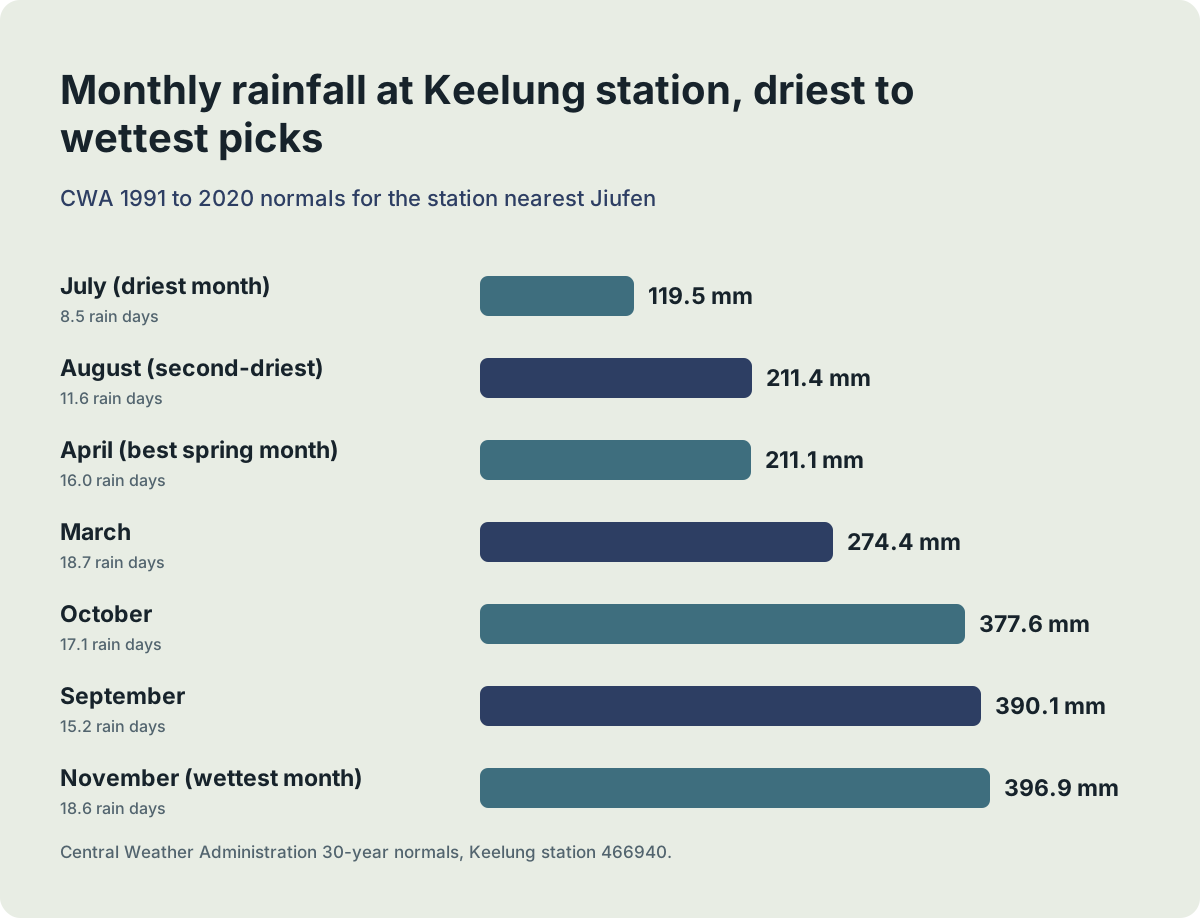
Two patterns deserve spelling out. First, September through February takes 2,198.8 mm of rain, 61 percent of the whole year's total in six months. That is the northeast monsoon in a single number, and it is why the autumn-and-winter travel advice that works for Taipei's west side fails here. Second, December is the dimmest month on the coast: 48.5 sunshine hours in the entire month, roughly 1.6 hours a day, with January close behind at 52.6. July, by contrast, gets 229.2 hours.
So the honest ranking for dry weather is: July first, August second, April third. If your dates are fixed outside those months, the rain-day column is your planning tool, not the rainfall column. March at 18.7 rain days is actually wetter day-to-day than November at 18.6, even though November carries more total water.
If your Jiufen visit is part of a wider Taiwan trip, the national picture is different from this coast's picture, and the month you pick for the island as a whole may not be the best month for Jiufen specifically. The trade-offs are laid out in what is the best month to go to Taiwan.
A dry-day plan also deserves a backup, because even in July the coast can serve up a stray wet afternoon. A guided circuit that covers the coast in one day makes the most of a good-weather window.
Should You Visit Jiufen On A Weekday Or A Weekend?
On any weekend, national holiday or make-up working day between 08:00 and 20:00, Jiufen is a managed-access destination under a New Taipei City traffic control plan in force since 1 January 2025, which rations coach access to roughly 20 approved coaches per half-day slot, suspends coach applications entirely on holiday runs of three or more consecutive days, and restricts coaches, not private cars and never pedestrians, so a weekday visit avoids the rationing altogether.
This is the strongest practical timing fact about Jiufen, and it comes from a signed government notice, not from blog folklore. The plan, notice 新北府交規字第1132450546號 dated 10 December 2024, amended the Ruifang, Jinguashi and Jiufen Area Holiday Traffic Control Plan with effect from 1 January 2025. Coaches must apply in advance to Ruifang Police Precinct, may not drive to Jiufen Old Street on their own, and are split into morning and afternoon slots of roughly 20 approved coaches each. Coaches that miss out drop passengers at New No. 9 car park or Shuinandong, and those passengers transfer to a shuttle for the last leg.
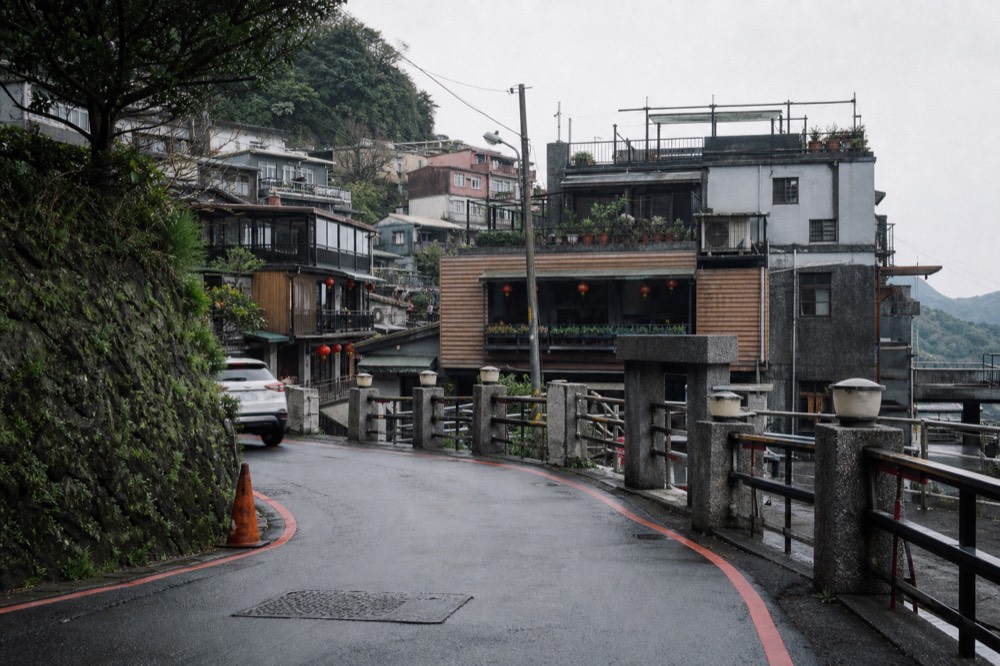
The plan also designates the stretch from Jiufen Police Station to the Quanjitang car park at Jinguashi a dangerous, accident-prone section where two vehicles cannot easily pass, barring large coaches except shuttles and scheduled services. The signed notice itself is published as a PDF of the official traffic control notice for anyone who wants the primary document.
| Factor | Weekday | Weekend or holiday |
|---|---|---|
| Coach access to Jiufen | No permit rationing in force | Applications required, roughly 20 per half-day slot |
| Long holiday weekends | Not affected | Coach applications refused entirely |
| Control hours | Not in force | 08:00 to 20:00 |
| Crowds on the old street | Lighter | Heaviest, roughly 10:00 to 17:00 by visitor reports |
| Weather advantage | Same climate data applies | Same climate data applies |
The practical reading: weather and day-of-week are two independent dials, and you control both. A wet Tuesday in March can still be a calmer, more atmospheric visit than a dry Saturday in July, because the Saturday brings the coach rationing, the shuttle transfers and the thickest crowds. Visitors consistently report the street as calm before about 09:00 and after about 19:00, with the heaviest crush through the middle of weekend days, and teahouses staying open later than the food stalls.
If you are committed to a weekend date, arriving by train rather than coach sidesteps the control plan entirely, since it restricts vehicles, not pedestrians. The rail option, including the fact that there is no direct train from Taipei to Shifen and you change at Ruifang, is covered in full in how to get from Taipei to Jiufen.
A guided tour is still a strong weekend choice, incidentally, because licensed operators are the ones who handle the permit system, and a weekend tour that includes the coast makes the most of a fixed date.
What About Typhoon Season And The Northeast Monsoon?
Typhoon risk on this coast runs through summer and early autumn, but the normals show summer is still the driest stretch of the year here, while the northeast monsoon from September through February delivers 61 percent of the annual rain as steady drizzle and fog rather than dramatic storms, so the two hazards need opposite planning responses: watch typhoon advisories in summer, expect persistent damp in winter.
Typhoons are a real summer consideration for Taiwan, and the correct move is simple: check the Central Weather Administration's advisories in the days before a summer trip and be ready to flex. A typhoon day can shut trains and the old street alike. But typhoons are discrete events, a day or two of disruption, while the monsoon is a season. The climate normals show what the monsoon does: September jumps to 390.1 mm from August's 211.4, and the totals stay above 320 mm every month through February.
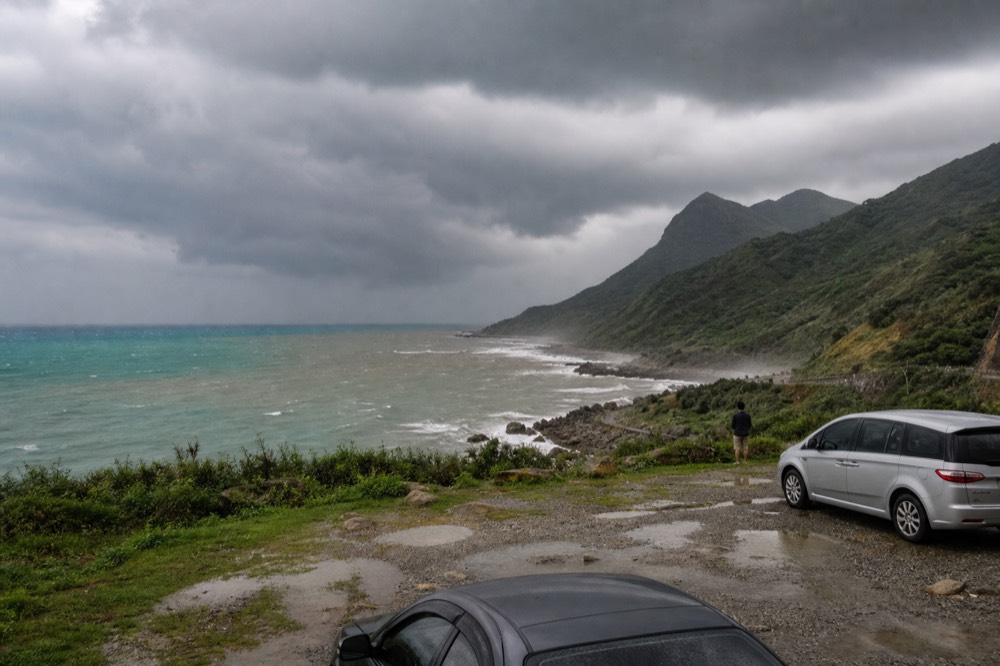
The character of the rain differs too, and it affects what you pack more than how much falls. Summer rain on this coast tends toward heavier, shorter bursts around a mostly usable day. Monsoon-season rain is the opposite: light, persistent, fog-generating, the weather that gives Jiufen its signature look and soaks a jacket slowly over hours. Neither the CWA dataset nor any verified source quantifies fog frequency here, so this page describes the fog and does not put a number on it.
| Season | Months | Dominant weather | Planning response |
|---|---|---|---|
| Plum-rain and early summer | May to June | Mixed showers, warm | Umbrella, flexible indoor stops |
| Peak dry window | July to August | Driest months, hot, typhoon watch | Best odds, monitor advisories |
| Monsoon arrival | September | Sharp rainfall jump | Rain gear, expect mist |
| Monsoon peak | October to February | Drizzle, fog, low light | Layers, waterproof, embrace the mood |
One more honest note on winter light: December's 48.5 sunshine hours mean roughly 1.6 hours of sun per day. If lanterns-at-dusk photographs are the goal, the lanterns come on around sunset whenever that falls, and no official source states a time, so plan around the sunset clock rather than a published lighting schedule. The evening experience, including why the night view is the town's strongest asset, is covered in Jiufen at night.
For a fixed-date trip where the forecast is uncertain, a private evening option gives the most schedule control.
What Time Of Day Has The Best Weather And Light?
Mornings are the most reliable window on this coast: visitor reports consistently describe the old street as calm before about 09:00, and the monsoon's fog often thins through the late morning, while the photographic golden hours are around sunrise and sunset, with the lanterns following sunset rather than any fixed clock, so an early start buys quiet streets and the best light in one move.
The crowd pattern and the light pattern point the same direction. Before 09:00, the street is quiet, shops are still opening, and the coach wave has not arrived. Through the middle of the day, roughly 10:00 to 17:00 on weekends, the street is at its thickest. After about 19:00 it thins again, and the teahouses, which stay open later than the food stalls, carry the evening.
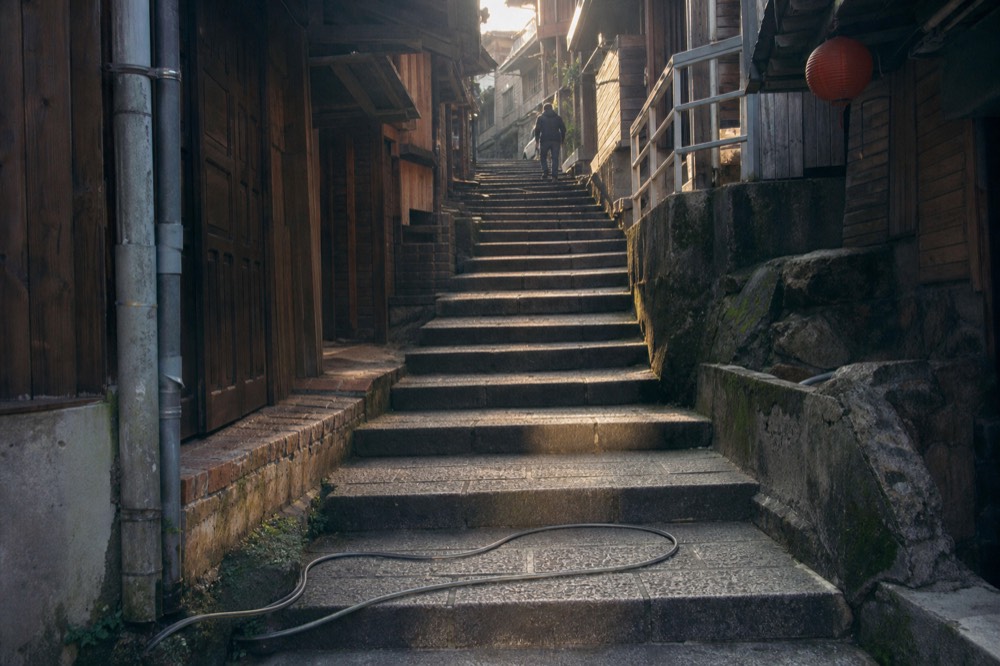
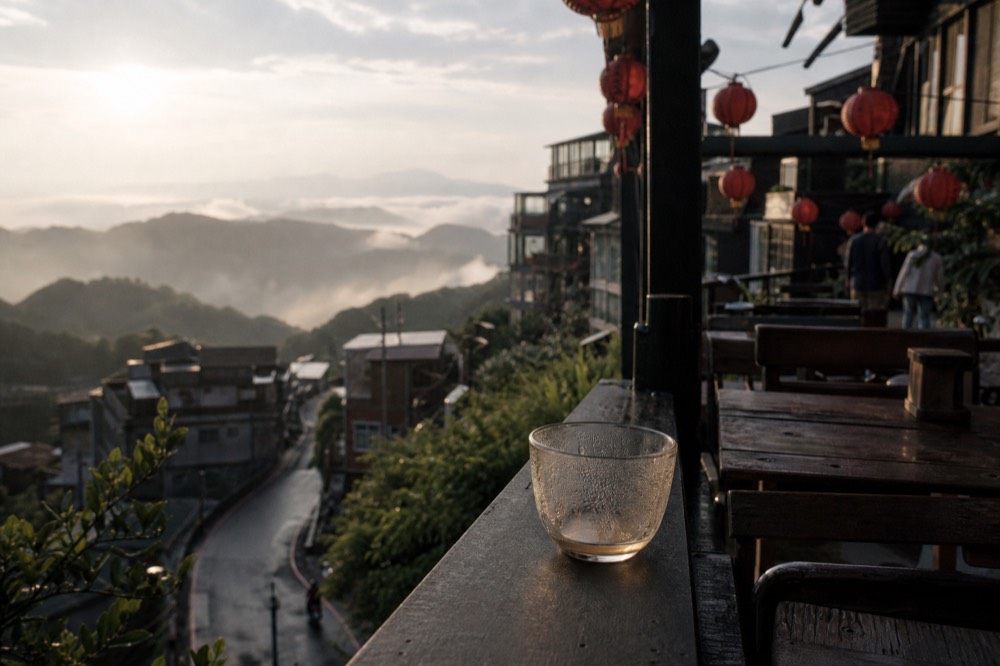
Fog behaves differently from rain here, and it is worth understanding before you write off a misty forecast. The monsoon fog that rolls up the hill in the morning often burns back toward the sea by late morning or midday, and the town can be above the fog layer when the coast below is in it. A grey 08:00 can turn into a spectacular 11:00 with the cloud sea below the town. No verified source quantifies how often this happens, so treat it as the pattern visitors describe rather than a promise.
| Time of day | Street conditions | Light and weather character |
|---|---|---|
| Before 09:00 | Quietest of the day | Morning mist common, soft light |
| 09:00 to 12:00 | Building | Fog often thinning toward midday |
| 12:00 to 17:00 | Heaviest, especially weekends | Brightest in summer, flat in winter |
| 17:00 to 19:00 | Thinning | Golden hour, lanterns near sunset |
| After 19:00 | Quiet again | Night view, teahouses open late |
The one product on this site built entirely around the evening window is a guided night walk of the old gold rush town, a smaller-volume listing that reaches the Golden Waterfall, the Gold Ecological Park area lookouts and the old street after dark. For most visitors, though, the simplest version of the early-start strategy is a half-day morning departure, and the Jiufen in-depth half-day tour, which goes to Jiufen and nowhere else, is the roster's only product of that kind.
How Cold Does Jiufen Get In Winter?
Winter on this coast is damp and dim rather than truly cold, with mean temperatures of 16.1 °C in January and 18.0 °C in December at the Keelung station, no snow, and the real winter problem being light: December averages just 48.5 sunshine hours for the whole month, so pack warm layers and waterproofs for the chill that damp air carries, not arctic gear.
The temperature column of the normals is the least dramatic part of the dataset, and that is the point. January, the coolest month, averages 16.1 °C. July, the warmest, averages 29.5 °C. Neither extreme shapes a visit the way the rain does. What makes a January day feel raw is 78.5 percent relative humidity, wind off the sea, and grey light, which is a layering problem, not a heavy-coat problem.
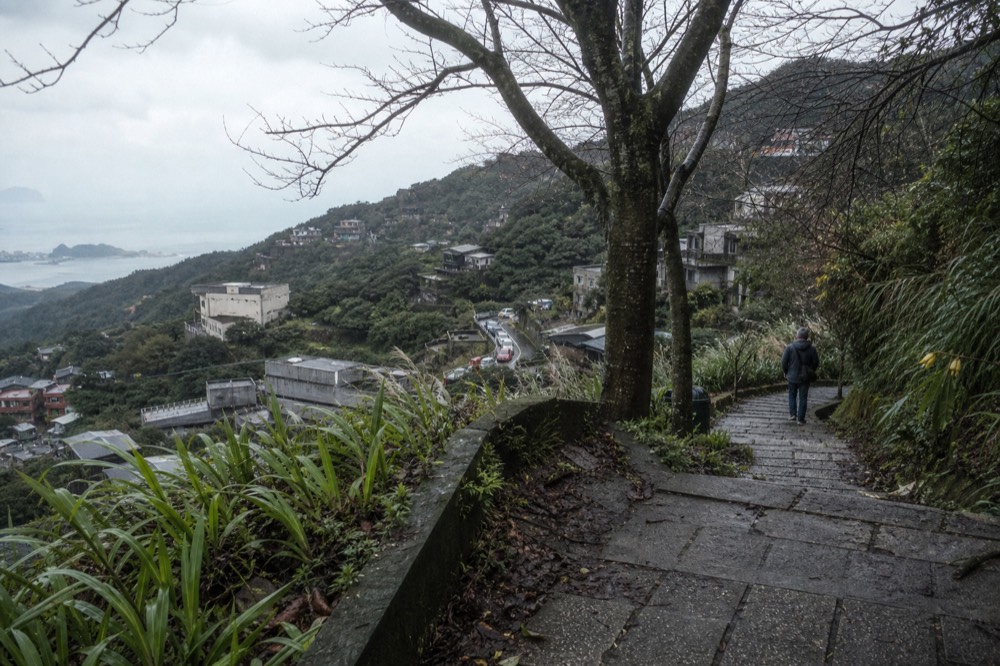
Snow is not part of this coast's climate at any month in the record. If cold-weather atmosphere is what you are after, the winter monsoon delivers it in a Taiwanese form: mist, low cloud, hot taro-ball desserts, and teahouse windows with the fog outside. That version of Jiufen has a genuine constituency, and the quieter winter weekdays are when you get it without the crowds.
| Month | Mean temp (°C) | Relative humidity | Feel on the hill |
|---|---|---|---|
| January | 16.1 | 78.5% | Damp, raw, quiet |
| April | 21.6 | 77.4% | Mild, fresh |
| July | 29.5 | 71.9% | Hot, humid, driest |
| October | 24.2 | 75.6% | Warm, increasingly wet |
| December | 18.0 | 76.6% | Cool, dim, drizzly |
What Should You Pack For Jiufen Weather?
Pack for rain first and temperature second: a real waterproof layer rather than an umbrella whenever possible, because the lanes are stepped and narrow and the monsoon drizzle is persistent, plus grippy shoes for wet stone and a warm mid-layer from October to March, while a summer visit needs sun protection and a compact rain shell for the odd burst, and every season rewards arriving early enough that you are not carrying it all through peak crowds.
The packing logic falls directly out of the data above. With 193.6 rain days a year at the coast station, rain gear is a year-round item, not a seasonal one. With mild means throughout the year, the layering matters more than the weight of any single layer. And with the street's stepped geography, wet stone underfoot is the actual hazard, so footwear outranks almost everything else in the bag.
| Item | July to August | April, May, June | September to February | Why |
|---|---|---|---|---|
| Waterproof jacket | Yes, light shell | Yes | Yes, proper one | 8.5 to 19.6 rain days depending on month |
| Umbrella | Optional | Yes | Yes | Narrow lanes, shared space |
| Grippy shoes | Yes | Yes | Yes, essential | Wet stepped stone |
| Warm mid-layer | No | Evenings only | Yes | 16 to 18 °C means, damp air |
| Sun protection | Yes, strong | Yes | Weak light, skip | 229.2 sunshine hours in July |
| Warm drink money | Optional | Yes | Yes | Teahouses are the rain shelter |
One note on the teahouses as weather infrastructure: they are the best rain shelter in town, and the one whose prices are fully verified is A-Mei Tea House, open 09:00 to 21:30 seven days, with a tea water fee of NT$100 per person and pots from NT$500, so two people sharing the cheapest pot pay NT$700 before food. The full breakdown, including the arithmetic most blogs omit, is in Jiufen's tea houses.
Jiufen Weather: The Short Version
For dry weather, aim for July, with August and April close behind; for the calmest streets, visit on a weekday and arrive before 09:00; and for the moody, lantern-lit Jiufen of the photographs, the monsoon months of October to February deliver it, at the cost of 18-plus rain days a month and barely 1.6 hours of daily sun in December. A weekday morning in July or April is the strongest single play the data supports.
Pulling the whole page into one decision. The dry-weather ranking comes from the Keelung normals, the crowd logic comes from the 2025 traffic control plan, and the atmosphere argument comes from the monsoon itself. Choose which of those three matters most to you and the month picks itself.
Whatever month you choose, a guided day that strings the coast together is the format that converts a good forecast into a full day well spent, and the strongest-rated option on this site for that job is the Yehliu, Jiufen and Shifen day tour with optional Tiaoshi Coast, rated 4.9 across 14,933 reviews, from $21.19 per person.
If that specific circuit does not fit your pace, the alternatives below cover the same coast with different trade-offs: a two-stop, unhurried option that confirms free cancellation, and an evening-oriented circuit built around the night view rather than the daytime street.
The short answers: July is the driest month on the nearest station's record, weekends bring both crowds and coach rationing under the 2025 traffic control plan, and there is no weather station in Jiufen itself, so every figure on this page comes from Keelung, about 12 km away on the same windward coast. The details below take each question in turn.
Common Questions About Jiufen Weather And The Best Time To Visit
What is the driest month to visit Jiufen?
July, on the Keelung station's 30-year normals: 119.5 mm of rain across 8.5 rain days. August is second at 211.4 mm and 11.6 rain days, and April is the best shoulder-season pick at 211.1 mm and 16.0 rain days.
Is summer a bad time to visit Jiufen?
No, and this is where the standard Taiwan advice fails for this coast. The nearest station's driest month of the year is July. Summer's real risk is typhoons, which are discrete events you can monitor through official advisories, not a season-long washout.
Is there a weather station in Jiufen?
No. The nearest official station is Keelung, about 12 km away on the same windward coast, and every figure on this page is a Keelung figure. The pattern transfers to Jiufen, and it is probably wetter up the hill, but no verified number exists for Jiufen itself.
Why is Jiufen so rainy compared with Taipei?
The northeast monsoon pushes moist sea air directly into this coast from autumn through spring, and the mountains rise immediately behind it. September through February delivers 61 percent of the year's rain at the coast station, which is why the town's reputation is fog and drizzle rather than downpours.
Are weekends worse than weekdays in Jiufen?
For crowding and access, yes. Since 1 January 2025, a city traffic control plan rations coach access on weekends and holidays between 08:00 and 20:00, roughly 20 approved coaches per half-day slot, and refuses applications entirely on holiday runs of three or more consecutive days. The plan restricts coaches, not private cars and never pedestrians.
Does it snow in Jiufen?
No. The coolest month, January, averages 16.1 °C at the coast station. Winter here is damp and dim rather than cold, with December averaging just 48.5 sunshine hours across the whole month.