Where In Taiwan Is Like Spirited Away?
The town most travellers mean when they ask this is Jiufen, but Studio Ghibli has denied the connection on the record. Here is what actually produces the resemblance, and how to see it.
Where In Taiwan Is Like Spirited Away?
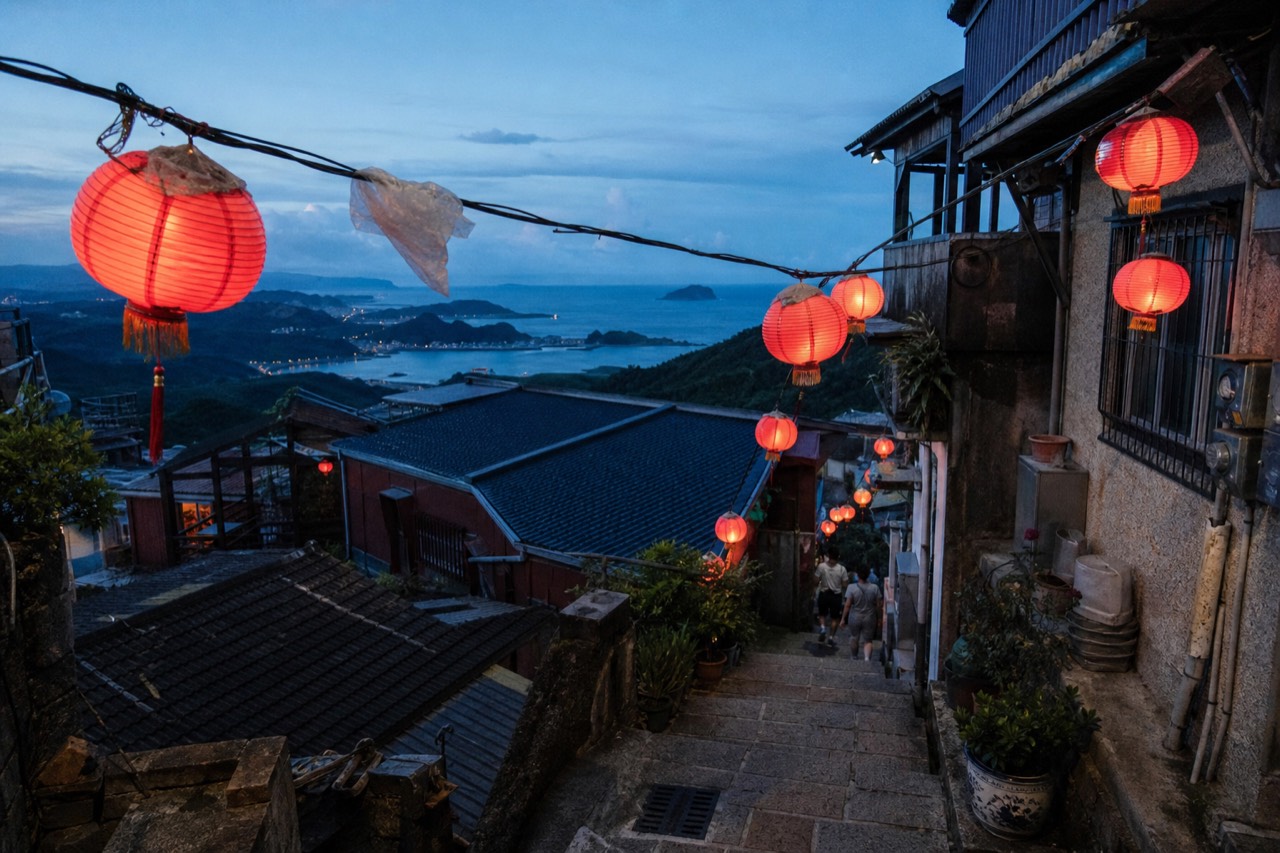
The town almost every traveller means by this question is Jiufen, the former gold-mining hillside village above Taiwan's northeast coast, and the resemblance people are chasing is genuinely there: stacked teahouses, red lanterns, stepped lanes and a sea view. But the causal claim is false. On 19 September 2023, Studio Ghibli producer Toshio Suzuki told Taiwanese media flatly that neither he nor Miyazaki has ever been to Jiufen.
That denial is on the record, in Taiwan's own language, published the same day by three separate Taiwanese outlets: ETtoday, Mirror Media and FTNN. Asked about the Jiufen rumour during promotion for The Boy and the Heron, Suzuki answered instantly, then denied it: "That's not true. Neither I nor Miyazaki has ever been to Jiufen." He went further. The moment of resemblance Miyazaki actually experienced, Suzuki said, came from an alley in Seoul, where the two men turned off a big road on a walk in Korea and Miyazaki was startled to find "the world of Spirited Away" there. FTNN's own headline framed the whole affair as the end of a 22-year misunderstanding.
So this page answers the question you actually have rather than the one you typed. You want to know where in Taiwan you can stand in the atmosphere of that film, and whether the famous rumour is true. The answer to the second part is no, and the answer to the first part is still Jiufen, because a resemblance does not need a causal link to be real. Suzuki himself said the rumour does not trouble him: it means people care about the work.
What follows is a practical guide to the look itself: which physical features of Jiufen produce it, when the town is at its most cinematic, which teahouse experiences actually deliver the scene, and how to time a visit so you get the lanterns and the fog without the worst of the crowds. If you want the full history of the claim and its denial, the companion piece Jiufen and the Spirited Away rumour covers it in depth. This site, Jiufen Tour, exists to separate the verifiable town from the cartoon attached to it.
For the atmosphere specifically, three in-town experiences do most of the work: a proper tea sitting in a historic teahouse, a sunset-to-lanterns evening, and a guided walk through the old mining town after dark.
Why Does Jiufen Look Like The Bathhouse In Spirited Away?
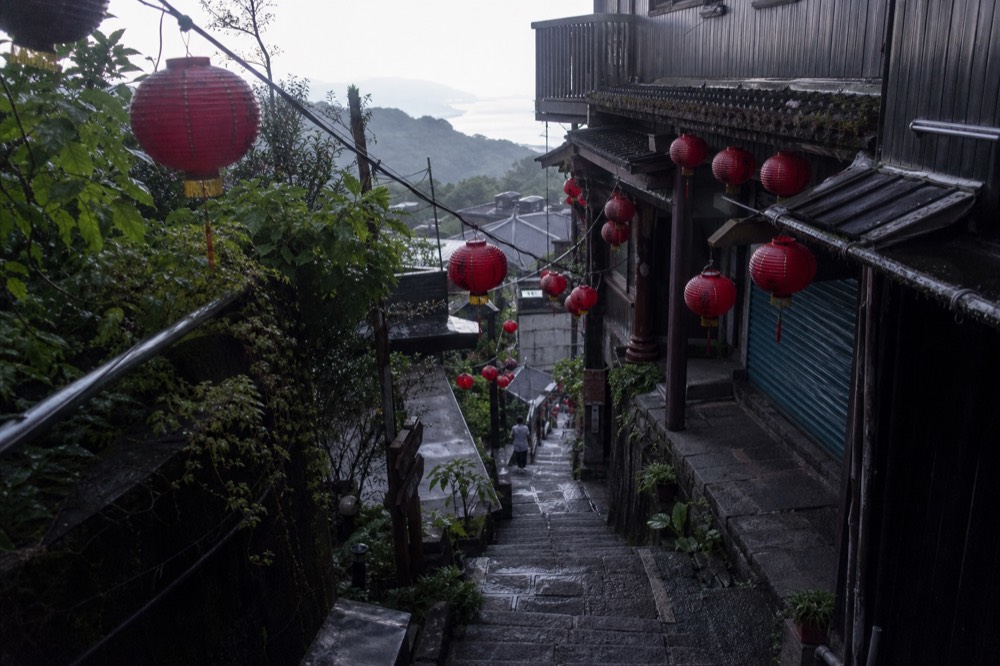
Because four physical features stack on top of each other in one small place: a hillside so steep the streets become staircases, teahouses built one above another with balconies facing the sea, red lanterns strung across narrow lanes, and a coastal fog that rolls in off the northeast monsoon. The film's bathhouse is a tall, layered wooden structure lit from within at night, and Jiufen at dusk accidentally reproduces that composition from almost any angle.
None of that was built for the resemblance. The town's shape comes from mining, and the street names record it. The New Taipei City Government's own 2016 release on the area's place names explains that Jishan Street means "the street that connects to the foot of Keelung Mountain", and Shuqi Road means "the road of many vertical steps". The quiet flat lane parallel to the old street, Qingbian Road, is the trackbed of a human-powered light railway laid in 1931, which is exactly why one lane is level and the next street over is a staircase. The town grew vertically because the hillside gave it no choice, and teahouses stacked up the slope because that is where the sea view is.
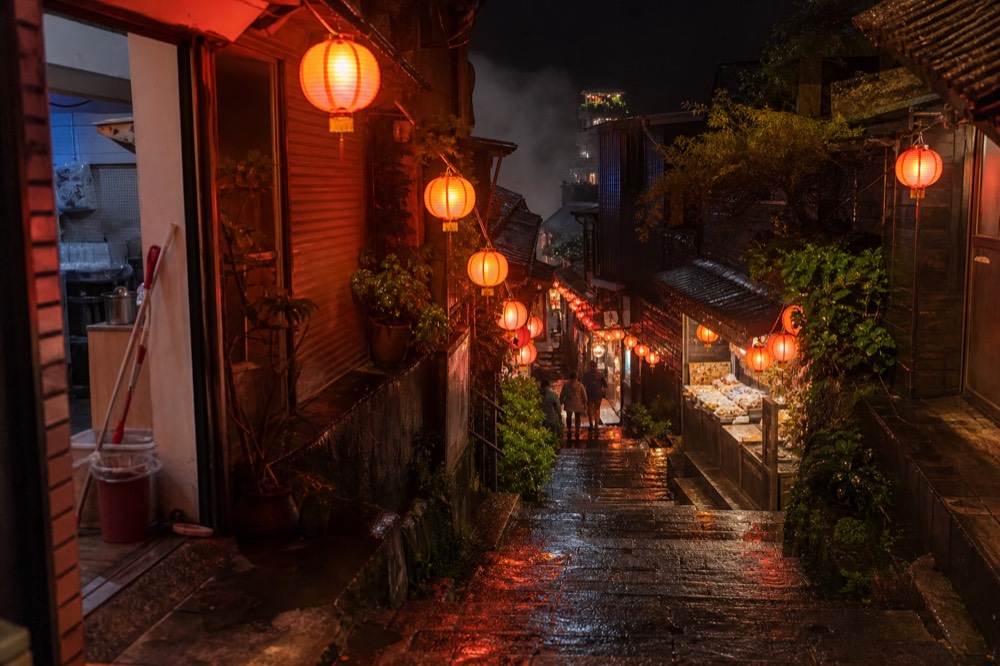
The lanterns are ordinary shop lighting that becomes extraordinary at dusk. No official source states what time they come on; every account says it follows sunset, which is the honest way to write it. What is verifiable is the effect: strings of red paper lanterns over a stone lane, teahouse windows glowing above and below, and the sea grey in the distance. On a foggy evening the layers blur into each other, and that is the moment people photograph and then mislabel as "the Spirited Away town".
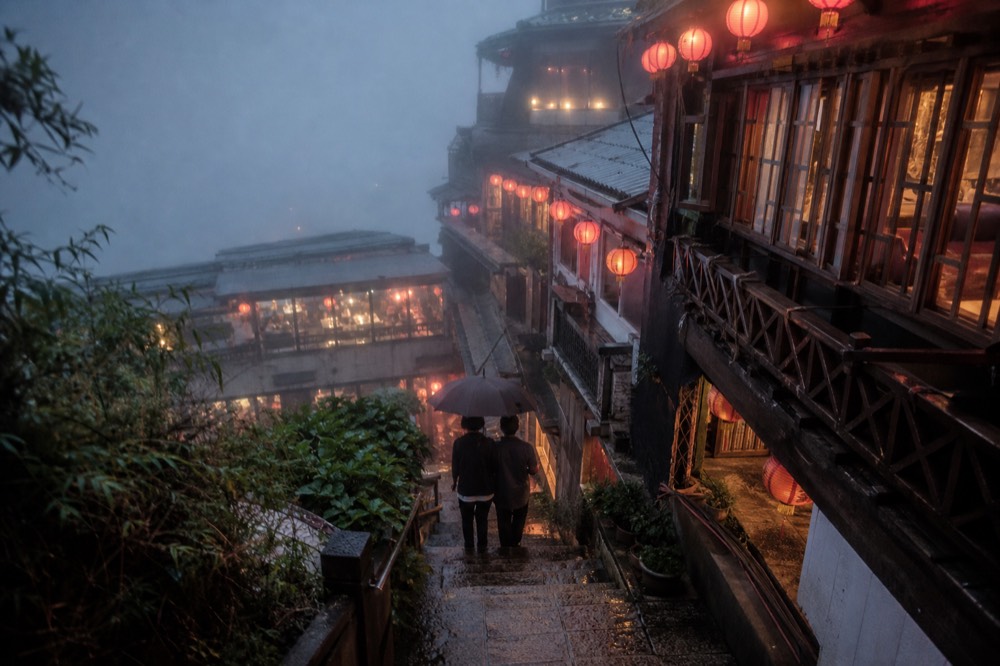
The fog is not a lucky accident either, it is climate. There is no weather station at Jiufen itself, so the honest numbers come from the Central Weather Administration's Keelung station about 12 km away on the same windward coast, using the 30-year normals for 1991 to 2020 published at the CWA's climate statistics page. Keelung records 3,589.7 mm of rain a year against Taipei's 2,329.5 mm, about 54% more, and it rains on 193.6 days a year, more than half of all days. September through February takes 61% of the year's rain in six months. That is the northeast monsoon, and it is why Jiufen's signature weather is fog and drizzle rather than tropical downpour, and why the town photographs the way it does for much of the year.
The deeper story of the town, from the 1890 gold strike that drew 4,000 prospector families and earned the nickname "little Shanghai" to the decline and the film-led revival, is covered in why Jiufen is famous. For the atmosphere, the short version is enough: a gold town emptied out, its wooden buildings survived, and the emptiness preserved the look that a full, prosperous town would have replaced decades ago.
Is There Really A Spirited Away Teahouse In Jiufen?
No, and the phrase should be retired. No teahouse in Jiufen has any documented connection to the film, and calling any of them "the Spirited Away teahouse" repeats a marketing association as if it were provenance. A-Mei Tea House, the most photographed of them, trades on the resemblance, and that is a fact about marketing, not about Studio Ghibli.
What you can honestly say about the teahouses is that they are the best reason to visit, with or without a cartoon attached. A-Mei Tea House is the only one whose prices and hours are verified from its own site: open 09:00 to 21:30 seven days, with a tea water fee of NT$100 per person before anything else, and pots of leaves from NT$500 for the cheapest (翠玉 or aged pu'er) up to NT$1,000 for Lishan oolong, per its own menu. The honest arithmetic most English pages skip: two people sharing the cheapest pot pay NT$100 + NT$100 + NT$500, so NT$700 before any food. A tea-and-snack set is NT$350 per person, and set meals run NT$300 to NT$350, served 10:30 to 13:30 only.
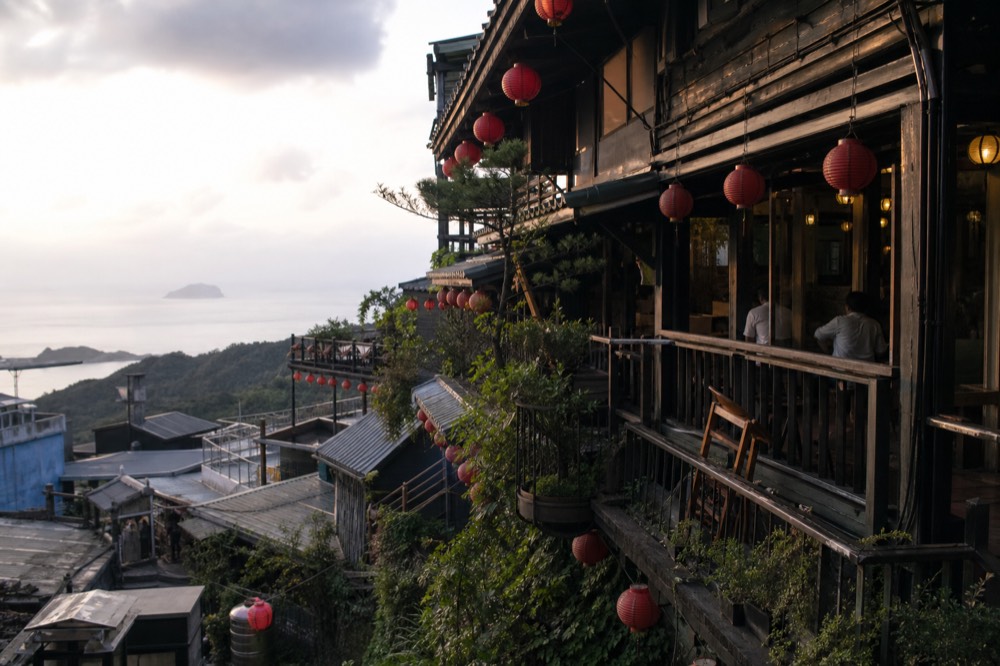
For the other teahouses, no verified prices or hours exist in any official source, so this site does not print any. What does exist is a set of bookable tea experiences redeemed in Jiufen itself, with prices and ratings on the live listings. These are not coach tours and nothing is boarded in Taipei; you redeem them in place, on the hillside.
| Experience, redeemed in Jiufen | What it is | Price on the live listing | Rating |
|---|---|---|---|
| Jioufen Teahouse voucher | A tea sitting at Jioufen Teahouse, an older romanisation of the same town's name, refreshments included | From $24.29 per person | 4.8 across 52 reviews |
| Haiyue Tower Landscape Teahouse | A tea sitting at a teahouse known for its elevated sea view, refreshments included | From $15.79 per person at the current sale price, standard $18.95 | 4.5 across 366 reviews |
| Jiufen Old Street Taiwan Tea Experience | Tea on the old street, bundled with an indigenous clothing experience | From $16.85 per person | 4.6 across 135 reviews |
The Jioufen Teahouse voucher is the closest thing to the scene people imagine when they ask this question: a tea tray, a wooden interior, and the hillside outside the window.
If the tea sitting is the centrepiece of your evening, it is worth locking a table before you travel, because the teahouses with the best windows are small and the sunset slots go first.
When Does Jiufen Look Most Like The Film?
At dusk, in the hour when the lanterns follow the sun down, ideally on a weekday outside the peak months, and ideally with the monsoon fog sitting halfway up the hillside. Visitors report the street is calm before about 09:00 and after about 19:00, and heaviest between 10:00 and 17:00 on weekends and holidays, which makes the late afternoon into evening the window that combines thinning crowds with the best light.
The weather side of that answer is where most planning advice for Jiufen goes wrong, because the usual "avoid Taiwan in summer" rule inverts on this corner of the island. The driest month on the Keelung normals is July, at 119.5 mm across 8.5 rain days, with August next at 211.4 mm. The wettest month is November at 396.9 mm, and December holds the sunshine record in reverse: 48.5 sunshine hours in the whole month, about 1.6 hours a day. If you want the fog, come between September and February. If you want dry photos, come in July. If you want both in one trip, gamble on a late-summer weekday evening after a shower.
| Month | Rainfall, Keelung normals | Rain days | What it means for the look |
|---|---|---|---|
| July | 119.5 mm | 8.5 | Driest month, clearest sea views, summer light |
| August | 211.4 mm | 11.6 | Second driest, hot evenings, lanterns early |
| November | 396.9 mm | 18.6 | Wettest month, heavy fog, the most atmospheric photos and the most umbrellas |
| December | 356.6 mm | 19.5 | 48.5 sunshine hours all month, about 1.6 hours a day, lanterns do the lighting |
The evening is also when the town's night economy comes alive, and there is a real difference between the day street and the night street. The full picture, including which food stalls stay open and where the night view points are, is in Jiufen at night. For the film-atmosphere question specifically, a guided evening walk does something a daytime coach circuit cannot: it puts you on the lanes after the day-trippers have gone, with someone explaining the mining town you are standing in. One such product, a guided night walk of the old gold rush town, runs from Taipei with hotel pickup and covers Golden Waterfall, the Gold Ecological Park area, the Gold Mine Museum, the Baoshishan lookout, the old street and the Jinguashi Thirteen-Level Ruins. It is a newer, smaller-volume listing, so it carries too few reviews for a star claim, at from $85 per person with free cancellation confirmed.
How Do You See The Spirited Away Look Without The Crowds?
Go on a weekday, arrive by train, and stay into the evening. On weekends and public holidays between 08:00 and 20:00, Jiufen is formally a managed-access destination under a New Taipei City traffic control plan in force since 1 January 2025: coach access is rationed to roughly 20 approved coaches per half-day slot and refused entirely during holiday runs of three or more consecutive days. A weekday removes most of that pressure at a stroke.
The train is the practical spine of the trip, and the numbers are solid. Taipei Main Station to Ruifang has 45 to 47 direct services a day, 32 to 68 minutes depending on class, with a median of 46 minutes. A Local costs NT$73 and a Puyuma express NT$114, and the express saves only about 13 minutes over the median local, so the local is the sensible default on this route. From Ruifang, local buses and the town's own shuttle network cover the climb to Jiufen. The full logistics, including the bus routes and the traffic plan in detail, are in Taipei to Jiufen.
| Choice | What it buys you | The trade-off |
|---|---|---|
| Weekday visit | Coach rationing does not apply, the street thins out by late afternoon | You may need to take leave; some shops run shorter weekday hours |
| Train to Ruifang, then bus up | 45 to 47 direct services a day from Taipei, NT$73 on a Local, no road-traffic exposure on the main leg | A transfer at Ruifang, and the last leg is a bus climb |
| Stay into the evening | The lantern-lit lane after the day crowd leaves, the sea view in the dark | A later return to Taipei; check the last trains when booking |
| Teahouse sitting in late afternoon | A seat, a pot of tea and a window as the light changes | Budget the real cost: at A-Mei, two people pay NT$700 before food |
One warning worth repeating, because it is the single most common planning mistake: many visitors try to bolt Shifen onto the same day expecting a through train. There is no direct train from Taipei to Shifen. You change at Ruifang, where the Pingxi branch runs 17 direct trains a day to Shifen at a flat NT$29, and the branch runs the same 17 trains on a Saturday as on a Monday, so the line gains no weekend capacity at all. If the sky lantern release is part of your picture of "Ghibli Taiwan", plan the transfer, and know that releasing a sky lantern is banned everywhere in New Taipei City except one marked stretch of the Keelung River valley around Shifen, under the city's 2011 sky lantern regulations.
Are There Other Places In Taiwan With A Ghibli Feel?
Yes, though none combines the ingredients as completely as Jiufen. Jinguashi, the next mining village over, has the ruins and the landscape with far fewer visitors. Shifen has the lanterns and the railway running through the street. Houtong has the cats and a river gorge. And Taipei itself, the Wanhua and Dadaocheng old quarters, has the alleys, though without the hillside or the sea.
Jinguashi is the honest second choice for atmosphere of the eerie, historical kind. The Gold Museum there charges NT$80 admission, opens 09:30 to 17:00 on weekdays and 09:30 to 18:00 on weekends, and is closed the first Monday of every month, a detail routinely missing from English pages and capable of wrecking a Monday plan. The Jinguashi Thirteen-Level Ruins and the Golden Waterfall, both regular stops on Jiufen-area tours, give the decaying-industrial backdrop that the film's more haunted scenes evoke. Describe the Golden Waterfall's colour as iron staining from the old mine workings, keep out of the water, and leave the chemistry to the scientists, because the cause of the nearby Yin Yang Sea's two-tone water is genuinely contested and this site does not adjudicate it.
Shifen produces a different kind of cinematic moment: a train line running down the middle of a village street, and sky lanterns rising over the valley in the only place in New Taipei City where releasing them is legal. The lanterns are a real, regulated spectacle, and the law behind them is more interesting than the souvenir version, from the 22:00 to 06:00 release ban to the rule that every lantern sold must carry the seller's name and address. That world is covered in Shifen Old Street and sky lanterns.
The one thing to keep straight, whichever of these you visit: none of them is a film location. The question "where in Taiwan is like Spirited Away" has a real answer, and the answer is a set of streets and lanterns and weather that genuinely look like a drawing, in a country whose most famous animation studio has said, on the record, that it never came here.
If the tea-and-lanterns evening is the version of the resemblance you want, these are the three experiences that deliver it most directly.
The short answers: Jiufen is the town that looks like the film, Ghibli has denied the connection on the record, no teahouse in Jiufen is a film location, and the best time to see the resemblance is a weekday evening at dusk. The details below cover each of those in full.
Common Questions About Jiufen And Spirited Away
Where In Taiwan Is Like Spirited Away?
Jiufen, the old gold-mining hillside town above Taiwan's northeast coast. Its stacked teahouses, red lanterns and stepped lanes produce the atmosphere people associate with the film. Studio Ghibli producer Toshio Suzuki denied on 19 September 2023 that Jiufen had anything to do with the film, saying neither he nor Miyazaki has ever been there, but the visual resemblance is real and worth the trip on its own terms.
Did Spirited Away copy Jiufen?
No, according to Studio Ghibli itself. Producer Toshio Suzuki, asked by Taiwanese media on 19 September 2023, said: "That's not true. Neither I nor Miyazaki has ever been to Jiufen." He said the alley Miyazaki reacted to was in Seoul, on a walk the two men took in Korea. Taiwanese media framed the denial as ending a 22-year misunderstanding.
Is A-Mei Tea House the Spirited Away teahouse?
No teahouse in Jiufen has any documented connection to the film, and this site does not call any of them that. A-Mei Tea House is the most photographed teahouse in the town and markets on the association, which is a fact about marketing rather than provenance. Its verified prices: a NT$100 per-person tea water fee, pots from NT$500, so two people sharing the cheapest pot pay NT$700 before food.
What is the real reference location for the Spirited Away bathhouse?
No Ghibli confirmation of any single location exists. Mirror Media reported Dōgo Onsen Honkan, a bathhouse in Matsuyama, Japan, as a real reference location for the film, and Suzuki himself described an alley in Seoul as the moment Miyazaki connected to the film's world. Anything more definite than that is rumour.
When should I visit Jiufen for the Spirited Away atmosphere?
Arrive late afternoon on a weekday and stay until after dark, when the lanterns come on around sunset and the day crowds leave. For fog, come between September and February during the northeast monsoon. For the driest weather, July is the driest month on the Keelung climate normals at 119.5 mm of rain, which inverts the usual advice to avoid Taiwan in summer.
Does Jiufen get crowded?
Yes, on weekends and holidays. On those days between 08:00 and 20:00 Jiufen is a managed-access destination under a New Taipei City traffic control plan, with coach access rationed to roughly 20 approved coaches per half-day slot and refused entirely on holidays of three or more consecutive days. Visitors report the street is calm before about 09:00 and after about 19:00, and busiest between 10:00 and 17:00 on weekends.