Why Is Jiufen Famous?
Jiufen is famous for four stacked reasons: a gold strike, a mining collapse, a 1989 film and a Ghibli rumour the studio itself denied. Here is what is actually true.
Why Is Jiufen Famous?
Jiufen is famous for four separate reasons, arriving in order: the 1890 gold strike that turned a poor village into a place the tourism authority's own page calls little Shanghai, the collapse of mining that emptied it, the 1989 film A City of Sadness, widely credited with reviving the town, and a rumour that Spirited Away was modelled here, which Studio Ghibli denied on the record in 2023. Only the last one fills the street today.
Most English pages flatten that history into a single sentence and get the emphasis backwards. They lead with the film connection, treat the gold rush as colour, and never mention that the strongest claim in the stack, the Ghibli one, has been publicly and specifically denied by the studio's own producer. The result is a town famous for a reason that is not true, while the reasons that are true sit unexplained behind the souvenir shops.
This page takes the four reasons one at a time, in the order they happened, and separates what is documented from what is marketing. The short version: the gold is real, the collapse is real, the film's effect is real but routinely overstated, and the Spirited Away resemblance is real to your eye while the causal claim, that Jiufen inspired the film, is false. It is the spine of Jiufen Tour as a site: check the claim before you print it.
| Reason | What is documented | What is not |
|---|---|---|
| The 1890 gold strike | Tourism Administration page: gold struck near Jiufen in 1890, 4,000 families of prospectors, nicknamed little Shanghai | Any production figure, any mine-closure date |
| The mining collapse | The town emptied as mining declined | The exact years and population figures that circulate |
| A City of Sadness (1989) | Widely credited with reviving the town | That the film documented-ly caused the revival |
| The Spirited Away rumour | The resemblance visitors see is real | That Jiufen inspired, modelled or set the film, denied in 2023 |
If you are planning a visit around the fame rather than the history, the practical spinoff is simple: the town's most famous experiences are the lantern-lit lanes at dusk, the teahouses, and the day-trip circuit that pairs Jiufen with Yehliu and Shifen. These three tours cover that ground well.
Why Is Jiufen So Famous?
Because a gold strike in 1890 turned a poor camphor-harvesting village into a boomtown that the Taiwan Tourism Administration's own English page says drew prospectors of 4,000 families and was called little Shanghai, and because the ruins of that boomtown, terraced lanes, mine tunnels and teahouses, survived the collapse intact enough to be rediscovered twice, once by a film crew and once by the internet.
Start with the name, because even that is widely misexplained. The familiar story is that nine households lived here and supplies landed from the coast had to be divided into nine portions, hence Jiufen, "nine portions". New Taipei City's own Gold Museum release of 6 January 2016 calls that story a legend and gives the account scholarly research prefers: before gold, the area lived by harvesting and boiling camphor, there were 90 camphor stoves, and ten stoves made one "fen", so there were nine fen. The Tourism Administration's English Jiufen page gives the same camphor-stove origin and never mentions nine families at all. The English internet has this backwards almost everywhere.
Then came gold. In 1890 someone struck gold near Jiufen, and the poor village soon attracted prospectors of 4,000 families, in the tourism authority's own words. The village was once called the gold city of Asia and nicknamed little Shanghai. Those three facts, the year, the families, the nickname, stand on a government page, which is more than can be said for most of the gold-rush colour that circulates: production tonnage, the years mining ended, the peak population of the district, all of it circulates without a primary source and none of it appears on this site.
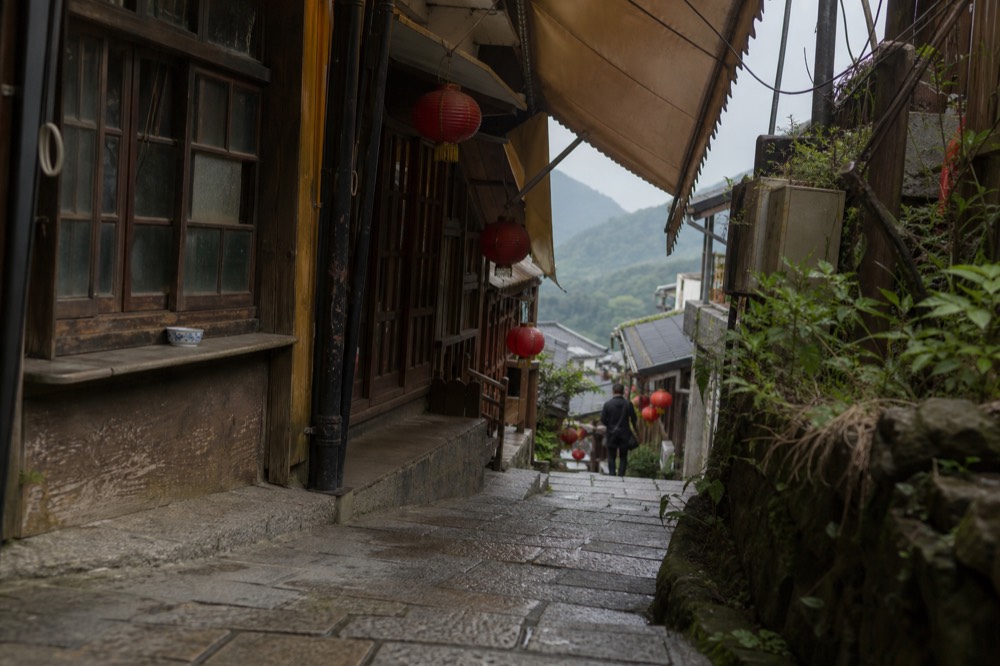
The physical legacy is what you actually walk through. The Jiufen mine had ten numbered tunnels running down the hill, and only Nos. 5, 8 and 10 still have intact portal exteriors; the bus stops in the lower town still carry the old pit names. The flat lane parallel to the main street, Qingbian Road, is the trackbed of a human-powered light railway laid in 1931, which is why one lane in this vertical town is level while the next one over, Shuqi Road, is named "the road of many vertical steps". The town's layout is mining infrastructure wearing a souvenir skin.
What Is Jiufen Famous For?
Today Jiufen is famous for its old street and teahouses, but its fame was rebuilt twice: mining collapsed and emptied the town, and then Hou Hsiao-hsien's 1989 film A City of Sadness, shot in these lanes, became the first Taiwanese film to win the Venice Golden Lion and is widely credited with reviving Jiufen as a destination, which is the honest ceiling for that claim, credited, not documented causation.
The collapse half of the story is the least told and the most necessary. A boomtown of 4,000 prospecting families does not fade gently. As the ore ran out and mining wound down, the town emptied, and the buildings, the narrow terraced lanes, the wooden-shuttered shopfronts, were left standing because nobody could afford to replace them. That neglect is the accidental preservation that later made the town photogenic. Ghost towns are rarely this intact.
Then the film. A City of Sadness, released in 1989, dramatised a Taiwanese family's life through political turmoil, and Jiufen stood in for the setting. Its festival success put the town back in front of Taiwanese audiences, and the revival that followed is real: shops reopened, teahouses started up, visitors returned. What is not documented is clean causation, that the film alone revived the town. Every serious account says "widely credited with", and that is the phrase this site uses too, because sharpening it into "the film saved Jiufen" is exactly the kind of unverified upgrade the Spirited Away story should have warned everyone about.
The fame the film started is measurable now, if you phrase it correctly. The Ruifang scenic area that contains Jiufen Old Street recorded 3,769,615 visitors in January and February 2026 alone, third in New Taipei City, per Tourism Administration scenic-spot statistics reported by NOWnews. Note the phrasing: the tourism authority counts the scenic area, never the street, and the scenic area's extent beyond the old street is not documented, so the figure belongs to that unit and nothing wider.
| Era | What happened | Source standing |
|---|---|---|
| Before 1890 | Camphor harvesting, 90 stoves, ten stoves per "fen", nine fen | Two official sources |
| 1890 | Gold struck near Jiufen, 4,000 prospecting families, little Shanghai | Tourism Administration page |
| Mining decline | The town emptied, buildings left standing | General account, no verified dates |
| 1989 | A City of Sadness, widely credited with reviving the town | Credited, not documented causation |
| 2023 | Studio Ghibli producer denies the Spirited Away claim | Three Taiwanese outlets, 19 to 20 September 2023 |
Why Is Jiufen Old Street Famous?
Jiufen Old Street is famous for its lantern-lit lanes, teahouses and stairways, an intact gold-rush streetscape where the main street, Jishan Street, means "the street that connects to the foot of Keelung Mountain" and the parallel lane is a 1931 railway trackbed, and for the dusk-to-dark hours when the red lanterns come on and the day-trippers have gone.
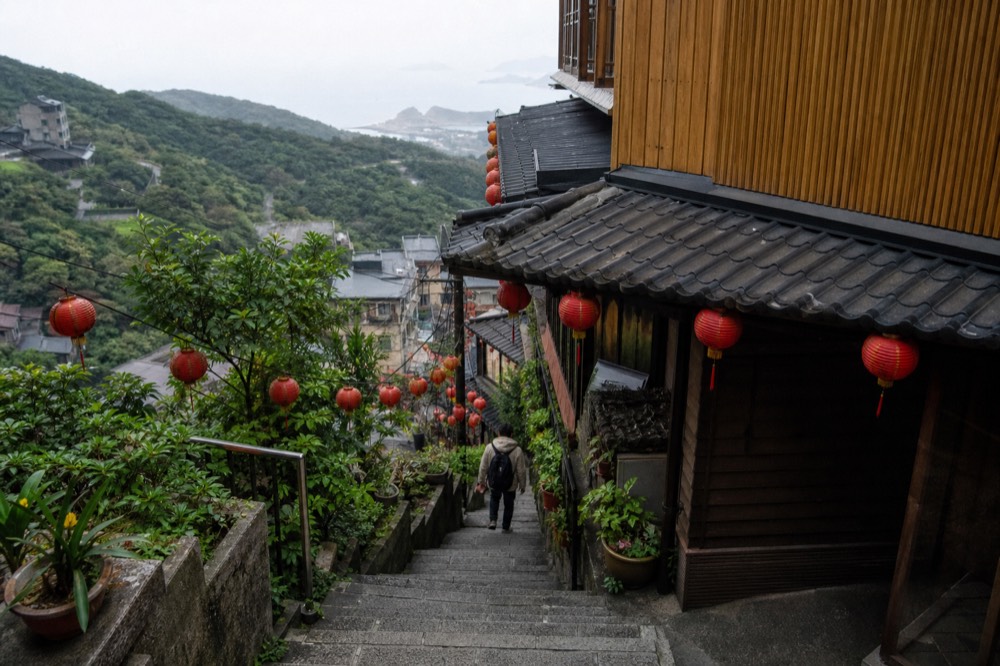
The street's fame is mostly a visual fame, and it is earned. Jishan Street, the spine of the old town, is a covered lane of food stalls and souvenir shops whose name, per the city's own place-name release, means "the street that connects to the foot of Keelung Mountain". Shuqi Road is the staircase that drops through the town's middle, named "the road of many vertical steps". Qingbian Road is the quiet flat lane that most visitors walk past without knowing it used to be a railway. That trio, one spine, one staircase, one trackbed, is the whole town in three names.
The teahouses carry a lot of the fame, and one of them carries the most. A-Mei Tea House, the multi-storey wooden building on the stone steps whose silhouette appears on half the postcards in town, is the only teahouse in Jiufen whose prices and hours are verified from its own site: open 09:00 to 21:30 seven days, a tea water fee of NT$100 per person, and pots of leaves from NT$500. Two people sharing the cheapest pot pay NT$100 + NT$100 + NT$500, NT$700 before any food. That is the honest floor, and it is arithmetic on the venue's own site and menu.
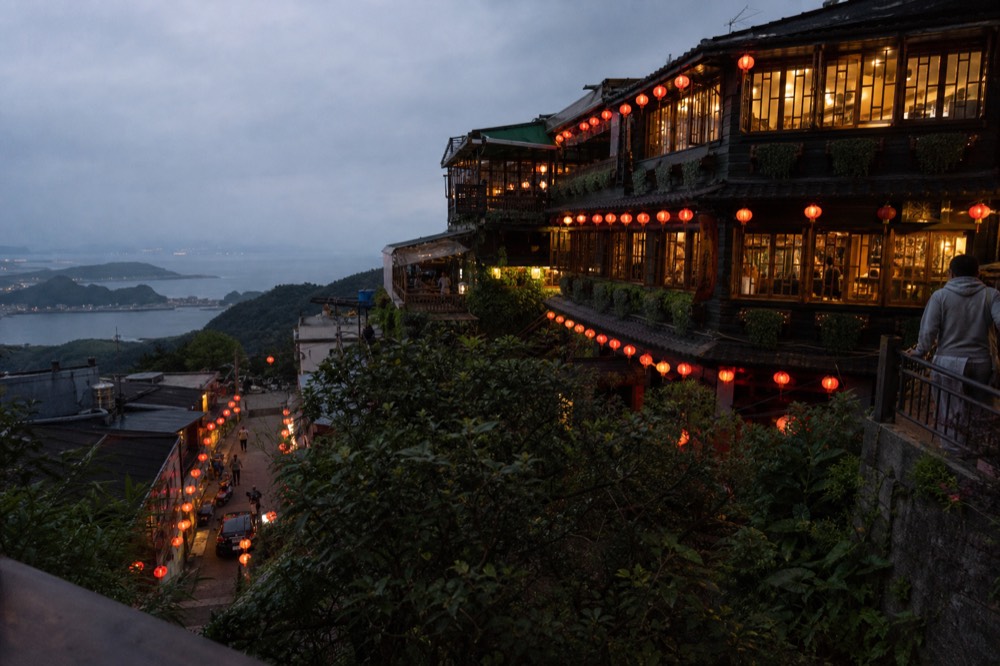
The lanterns deserve a careful sentence. The red lanterns strung across the lanes come on around dusk, and no source states a time, because it follows sunset and the shopkeepers, not a schedule. What is verifiable about lanterns in this region is legal rather than scenic: releasing a sky lantern is banned everywhere in New Taipei City except one marked stretch of Pingxi, from the Shifen Visitor Center to Shigong Bridge, under the city's sky lantern release management measures. The red lanterns of Jiufen are decoration, and the flying lanterns people associate with the area are a Shifen thing, a distinction this site keeps sharp because the two towns get blurred constantly.
If the old street itself is what you came for, there is exactly one roster product that goes to Jiufen and nowhere else: the Jiufen In-depth Half-Day Tour, from $26.55 per person, morning or afternoon departure from Taipei Main Station, rated 4.9 across 267 reviews, with free cancellation confirmed. It is the closest thing on the market to a guided answer to this section's question.
What Is Jiufen Old Street Known For?
Jiufen Old Street is known for the Spirited Away rumour more than for anything it actually did, which is the strangest part of its fame: the town's single biggest draw is an association Studio Ghibli's own producer denied on 19 September 2023, saying "That's not true. Neither I nor Miyazaki has ever been to Jiufen", while the resemblance that fuels the rumour is genuinely visible in the lanes and worth seeing on its own terms.
Here is the denial in full, because it deserves to be carried rather than paraphrased. On 19 September 2023, Studio Ghibli producer Toshio Suzuki, interviewed in Tokyo by Taiwanese media during promotion for The Boy and the Heron, was asked about the Jiufen claim and answered instantly, then denied it: "That's not true. Neither I nor Miyazaki has ever been to Jiufen." He said the moment of resemblance Miyazaki actually had came from an alley in Seoul, turning off a big road on a walk the two of them took in Korea. He added that the rumour does not trouble him, it means people care about the work. Three Taiwanese outlets, ETtoday, Mirror Media and FTNN, published the same quotes the same day, and FTNN's own headline framed the story as ending a 22-year misunderstanding.
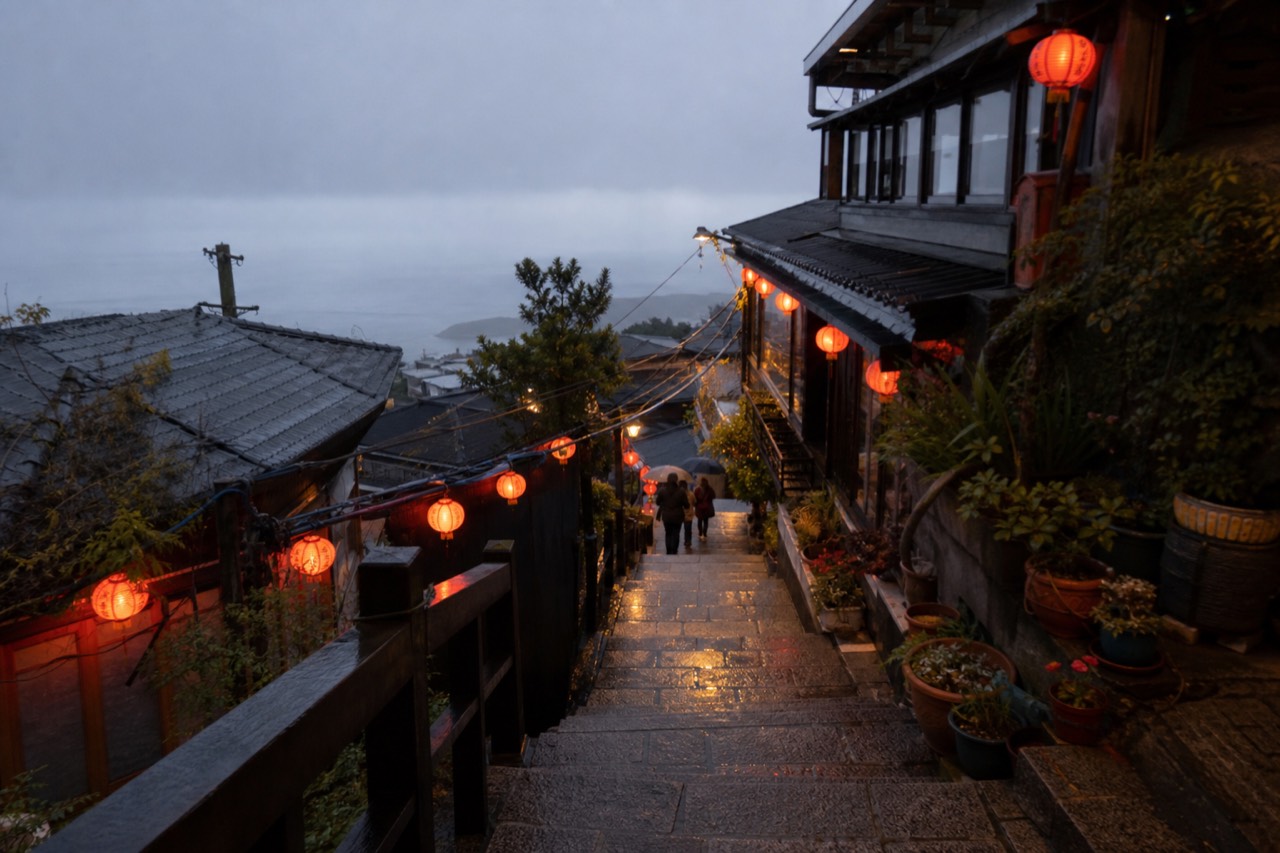
What survives the denial is the resemblance, and this site's position on it is plain: the resemblance is real and the causal claim is not. A visitor walking Shuqi Road at dusk, red lanterns overhead, wooden balconies stacked above the steps, steam from food stalls, will see why a generation of internet posts connected this place to the film's bathhouse town. The eye is not wrong. The story about how the film was made is wrong, and no teahouse in Jiufen, A-Mei included, is "the Spirited Away teahouse", because A-Mei markets on the association and marketing is not provenance.
| Claim about Jiufen and Spirited Away | Status |
|---|---|
| Jiufen inspired / modelled / set the film | Denied by Studio Ghibli's producer, 19 September 2023 |
| Miyazaki visited Jiufen or Taiwan | Denied: "Neither I nor Miyazaki has ever been to Jiufen" |
| Any teahouse is "the Spirited Away teahouse" | Marketing association, not provenance |
| The resemblance visitors see in the lanes | Real, and worth seeing on its own terms |
| Where the resemblance Miyazaki described came from | An alley in Seoul, per Suzuki's own account |
The honest framing, and it is better copy than the rumour, is that Jiufen is famous for looking like a film it had nothing to do with, while being the real set of a different masterpiece. A City of Sadness was actually shot here. If you want the cinematic Jiufen, that is the film to watch on the train out, and its effect on the town is the one revival story with a paper trail.
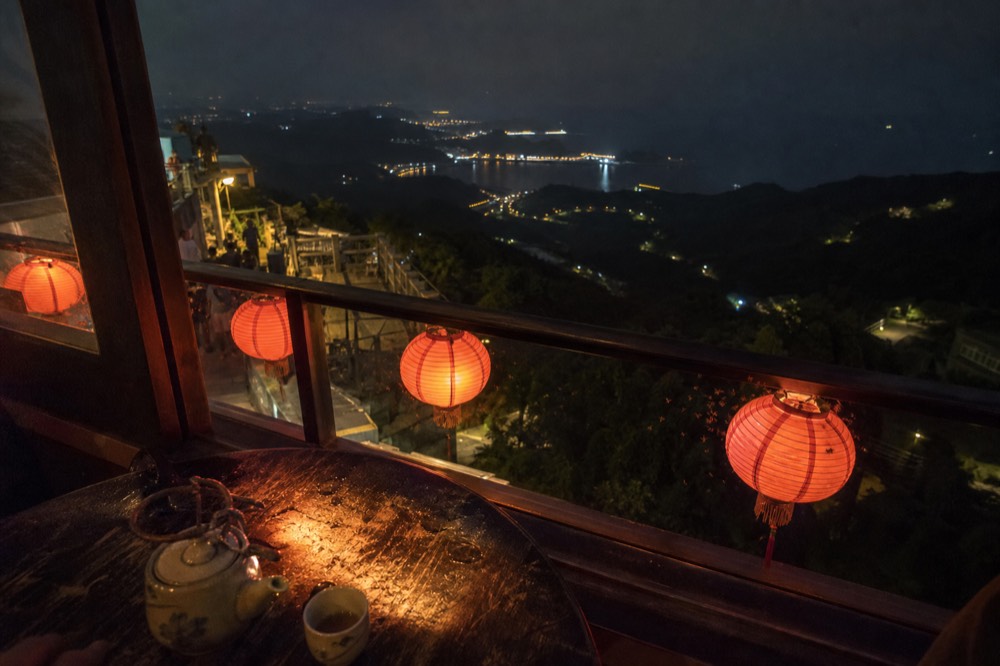
The dusk-to-dark hours are when the rumour, the film and the gold rush all look the same. The pattern visitors report, and it is a report, not an official schedule, is that the street is heaviest through the middle of the day and calmer before about 09:00 and after about 19:00, with teahouses staying open later than the food stalls. The one hard, official fact about visiting on a weekend is stronger than any guidebook generalisation: under New Taipei City's holiday traffic control plan in force since 1 January 2025, Jiufen is a managed-access destination between 08:00 and 20:00 on weekends and holidays, coach access is rationed to roughly 40 approved coaches a day, and coach applications are refused entirely during holiday runs of three or more consecutive days. The plan restricts coaches, not private cars and never pedestrians.
For the evening version of the town, the tour built around exactly this hour is the Jiufen A-Mei Teahouse, Sunset at Heping & Keelung Night Market tour, from $58.90 per person, rated 4.7 across 866 reviews. Its stops are Jiufen Old Street, Heping Island and Keelung Miaokou Night Market, with an optional A-Mei Teahouse tea set, and despite how it is indexed in many places, it reaches neither Yehliu nor Shifen. It is the roster's clearest dusk-and-after-dark product.
So Which Reason Should Shape Your Visit?
All four, in one day if you time it: walk Qingbian Road because it is a 1931 railway trackbed, stand at an intact mine portal because of 1890, watch A City of Sadness beforehand because it was actually shot here, and be at the steps at dusk for the lanterns, which look like a film they had nothing to do with and are beautiful regardless, which is the only version of the Ghibli story that survives the facts.
The practical reading of this town's fame is that Jiufen rewards the visitor who knows which layer they are looking at. The gold layer is under your feet and named in the bus stops. The collapse layer is why the buildings survived. The film layer is Taiwanese, not Japanese, and it is the true cinema connection. The rumour layer is the crowd, and it is harmless as long as nobody sells it to you as fact, which one teahouse's marketing and a thousand blog posts will attempt.
Go on a weekday if you can, go by train, and stay past the departure of the day-trip coaches. The evening town is the one the postcards promise, and it needs no studio's endorsement to justify the trip. For more on each layer, see the old street guide, the Spirited Away fact check, and what to eat on the street.
The four questions below are the ones visitors actually type, and each answer keeps the same discipline as the page above: the gold, the collapse and the film are stated at exactly the strength the sources support, and the Spirited Away claim is answered with the studio's own denial rather than a hedge, because a hedged rumour is still a rumour travelling.
Common Questions About Jiufen's Fame
Why Is Jiufen Famous?
Four stacked reasons: the 1890 gold strike that drew 4,000 prospecting families to a village nicknamed little Shanghai, the mining collapse that emptied and accidentally preserved it, the 1989 film A City of Sadness, widely credited with reviving the town, and a Spirited Away rumour that Studio Ghibli denied on 19 September 2023. Only the last brings today's crowd.
Why is Jiufen so famous?
Because a documented gold boom in 1890, the tourism authority's own page records the strike, the 4,000 families and the little Shanghai nickname, left behind an intact boomtown streetscape that a famous Taiwanese film then revived and the internet then rediscovered. The fame is layered, and the oldest layer is the best documented.
What is Jiufen famous for?
Its old street, its teahouses, its stairways and its dusk lanterns, all of which sit on real gold-rush infrastructure: Jishan Street, Shuqi Road and the flat Qingbian Road, a 1931 light-railway trackbed. It is also famous for A City of Sadness (1989), which was shot here, and for a Spirited Away association the studio has denied.
Why is Jiufen Old Street famous?
Its lantern-lit lanes and stacked wooden buildings, an intact gold-rush streetscape that survived because the town emptied, and the evening hours when the red lanterns come on around dusk. The street's names are themselves mining history: the spine, the staircase and the old railway trackbed.
What is Jiufen Old Street known for?
The Spirited Away rumour, more than anything it actually did, which is the strangest part: its biggest draw is an association Ghibli's producer denied outright in 2023, saying neither he nor Miyazaki ever visited Jiufen. The resemblance visitors see is real; the causal claim is not. No teahouse here is "the Spirited Away teahouse".
Did Spirited Away inspire Jiufen's tourism?
The rumour helped the town's international fame, but the direction of the claim is backwards: the story says Jiufen inspired the film, and Studio Ghibli has denied that on the record. The revival that is actually credited, widely, is A City of Sadness in 1989, which was genuinely shot in the town.