Jiufen Old Street: The Three Streets That Make Up Taiwan's Most Famous Hill Town
Every ranking page calls Jiufen Old Street a single street. It is three, and a 2016 New Taipei City Government release explains exactly why the town is laid out the way it is: a covered food alley, a road named for its vertical steps, and a flat lane that used to be a railway.
Short answer
Jiufen Old Street is three parallel routes through the hill town: Jishan Street, the covered food alley; Shuqi Road, the stair lane; and Qingbian Road, the flat trackbed of a 1931 human-powered light railway. No official body publishes opening hours for the street itself; visitors report most shops run roughly 10:00 to 19:00.
Jiufen Old Street is the most searched destination in this corner of Taiwan, and almost every English page about it makes the same mistake at the first sentence: they treat it as one street. It is three, running parallel down the same hillside, and each exists for a reason recorded in an official New Taipei City Government release of 6 January 2016, issued by the Gold Museum. Jishan Street is the covered food alley, the one in every photograph. Shuqi Road is the stair lane, its name literally meaning "the road of many vertical steps". Qingbian Road is the quiet flat lane, and it is flat because it is the trackbed of a human-powered light railway laid in 1931 by the Ruifang Light Railway Company, founded by Yan Guonian.
That release is the backbone of this guide. It gives the meaning of each street name, the history of the railway that explains the town's shape, and the reason the flat lane and the stair lane sit side by side. What it does not give, and what no official body publishes, is a set of opening hours for the street or its shops, so the hours below are what visitors consistently report rather than an official timetable, since no authority publishes set times for the street's shops and teahouses. This site, Jiufen Tour, builds every page on that same principle: verified figures only, and where nothing official exists, the reported pattern is labelled as exactly that.
What Is Jiufen Old Street, Actually?
Jiufen Old Street is the collective name for three parallel routes down Jiufen's hillside: Jishan Street, the covered food alley whose name means "the street that connects to the foot of Keelung Mountain"; Shuqi Road, the stair lane; and Qingbian Road, the flat lane that was the trackbed of a 1931 light railway. The town grew around a gold strike in 1890 and was once called little Shanghai.
The gold rush origin is on the Taiwan Tourism Administration's own English page: in 1890 someone struck gold near Jiufen, the poor village drew prospectors of 4,000 families, and it was called little Shanghai. The same national tourism body's page gives the pre-mining economy, and it is not gold. Before the boom the area lived by harvesting and processing camphor, with 90 camphor stoves, and ten stoves generally grouped together in a processing site, which is where the name comes from: nine units, nine "fen".
The familiar "nine families, nine portions" story is what the city itself calls a legend. The 2016 release describes it as a 傳說, then says scholarly research holds the camphor-stove account to be the more correct origin, and the Tourism Administration's English page never mentions nine families at all. The English internet has this almost uniformly backwards, which is a good reason to read the primary sources rather than the listicles. You can check the city's own release at the New Taipei City Government page and the tourism body's version at the Taiwan Tourism Administration's Jiufen page.
What Is On Jishan Street, The Covered Food Alley?
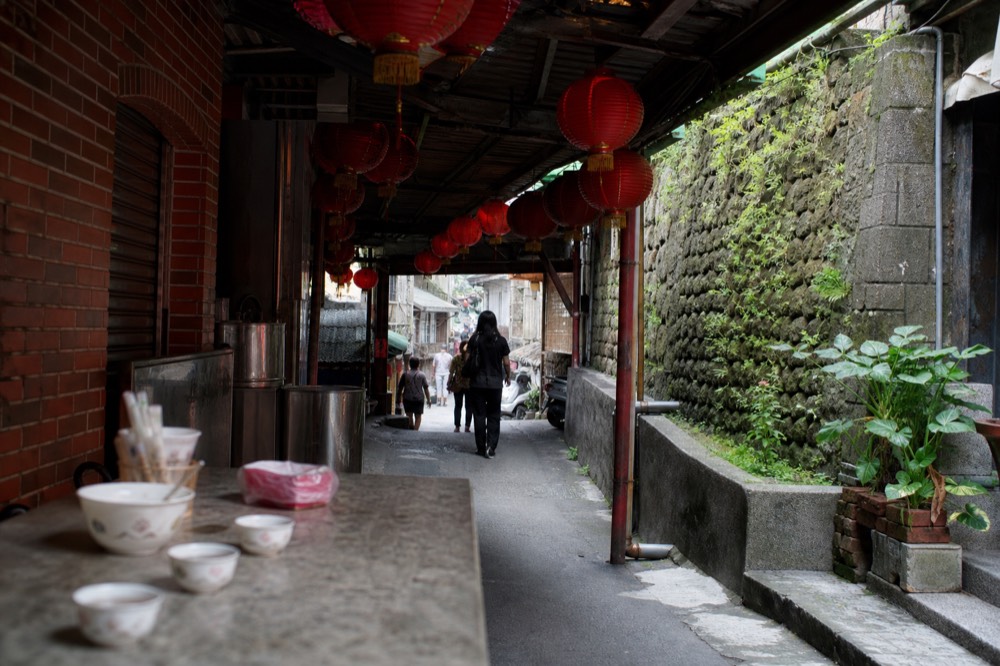
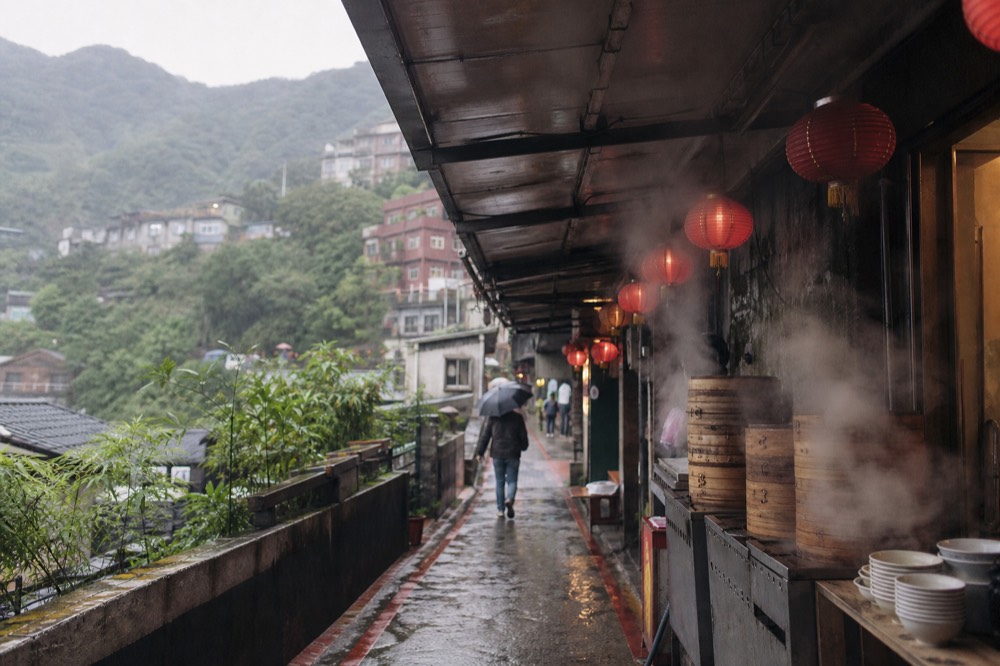
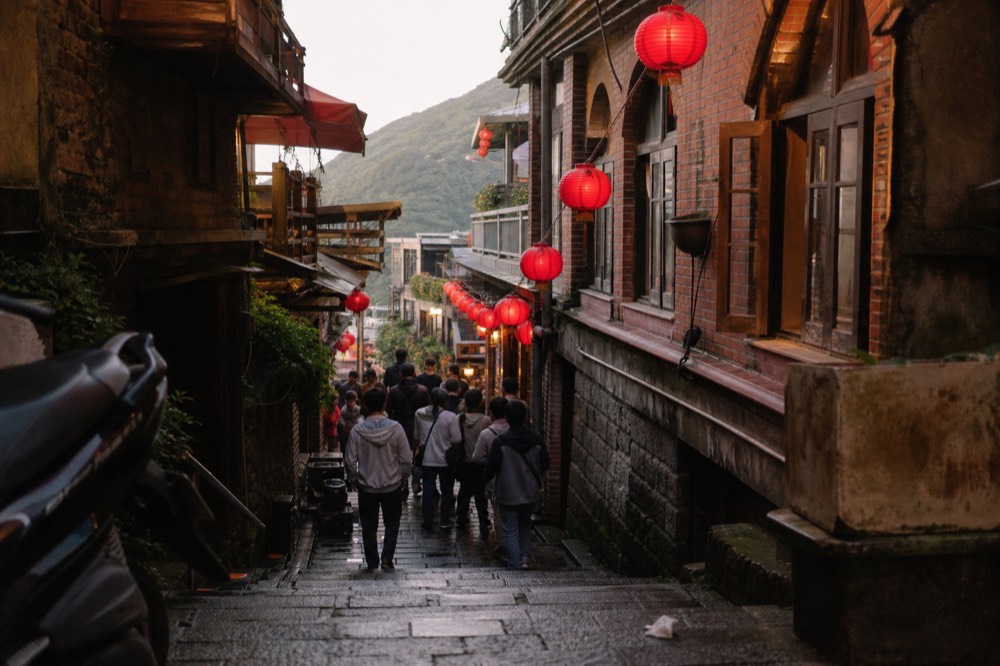
Jishan Street is the covered main lane, the one in the photographs: a narrow alley of food stalls and old shopfronts under roofs and red lanterns, whose name means "the street that connects to the foot of Keelung Mountain". It carries the heaviest crowding, roughly 10:00 to 17:00 on weekends and holidays, and it is where the crowd actually stops and queues.
The covering is the point. The buildings lean over the lane and the shop roofs meet overhead, which is why the street glows in the late afternoon: the lanterns hang in a corridor of shade. Food dominates. Taro ball desserts, taro and sweet potato in syrup, fish ball soup, squid thick soup, pastries and tea snacks line both sides, and the stall fronts are mostly unchanged shophouses from the mining era. Note that no verified source places the invention of taro balls in Jiufen; the town is known for selling them, not inventing them, so treat any stall claiming to be the inventor with the skepticism the record deserves.
Where the crowd actually stops is predictable: the first stretch from the old street entrance, where the covering is densest and the photographs are easiest. Walk past the first clusters and the lane thins noticeably, because most visitors turn around within the first few shop rows and never reach the far end where Jishan Street meets the stair lanes. The calm before about 09:00 and after about 19:00 is the pattern visitors consistently report, not official hours, and no body publishes any.
If you would rather have someone else handle the logistics of the day, these three options cover the range.
What Is Shuqi Road, The Stair Lane?
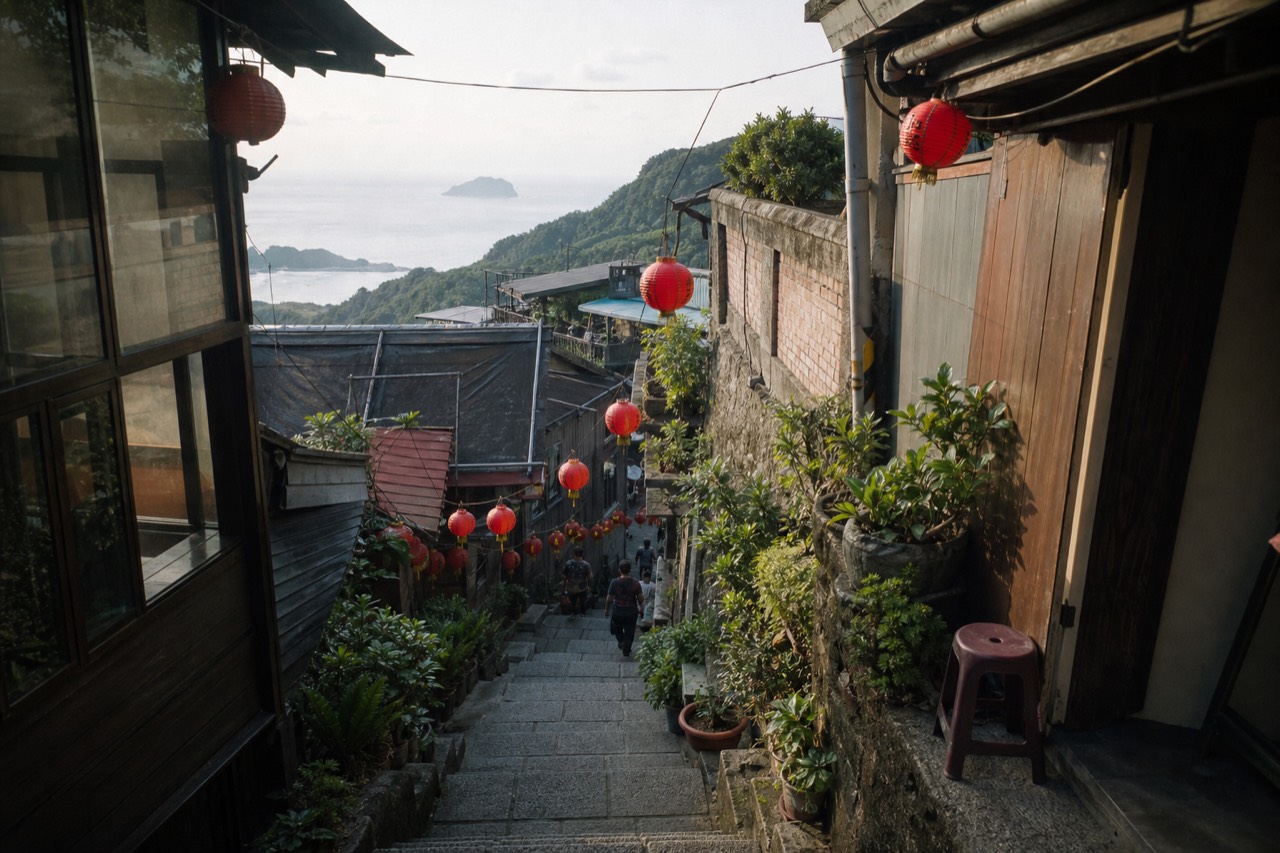
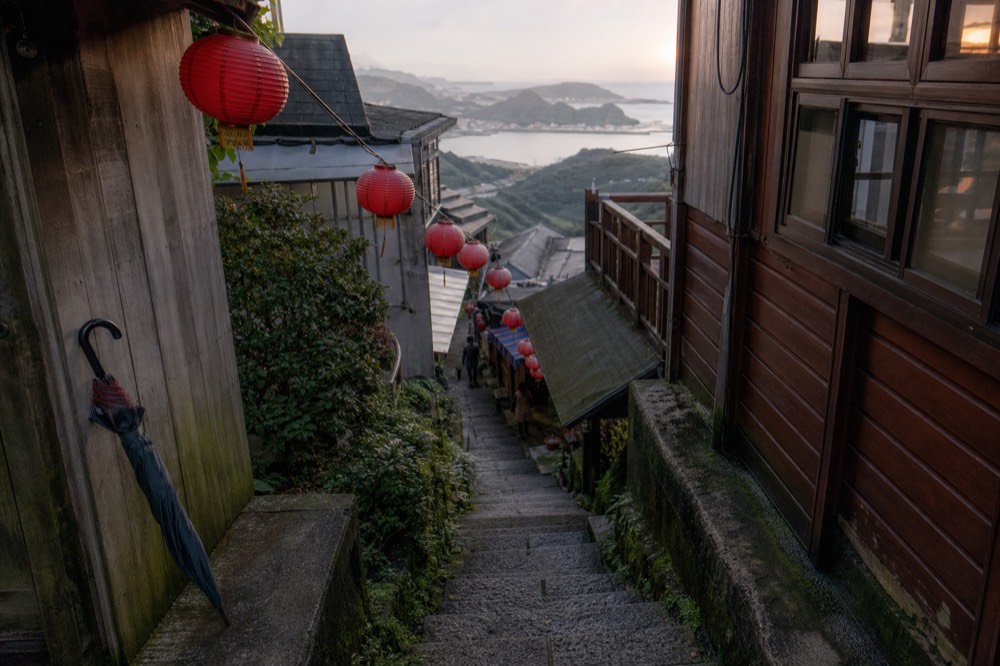
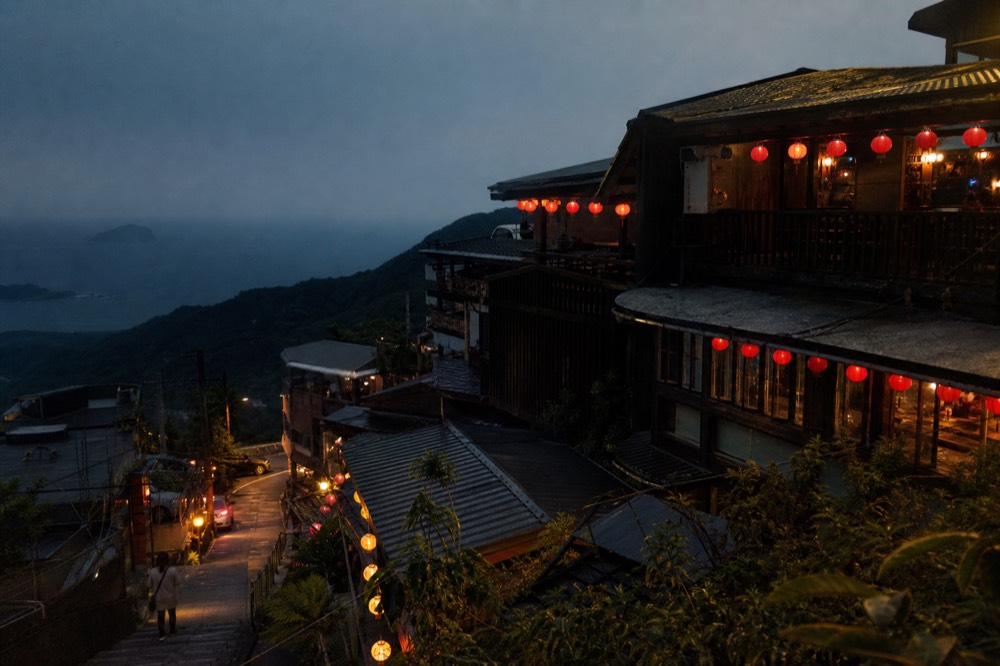
Shuqi Road is the stone stair lane that drops steeply through the middle of Jiufen, and its name, given in the city's own 2016 release, means "the road of many vertical steps". It is the most photogenic and the most physically demanding of the three streets, lined with teahouses including A-Mei Tea House, and it is where the classic stair-and-lantern photographs are taken.
The stairs are the identity of the town's vertical axis. Where Jishan Street runs along the contour, Shuqi Road cuts straight down it, and the 2016 release is explicit that the name describes exactly that. No official source publishes a step count, a gradient or an elevation figure for this lane or for the town, and this page will not invent one. What the record does establish is what the stairs connect: teahouses, guesthouses and lookouts stacked on the way down toward the sea view.
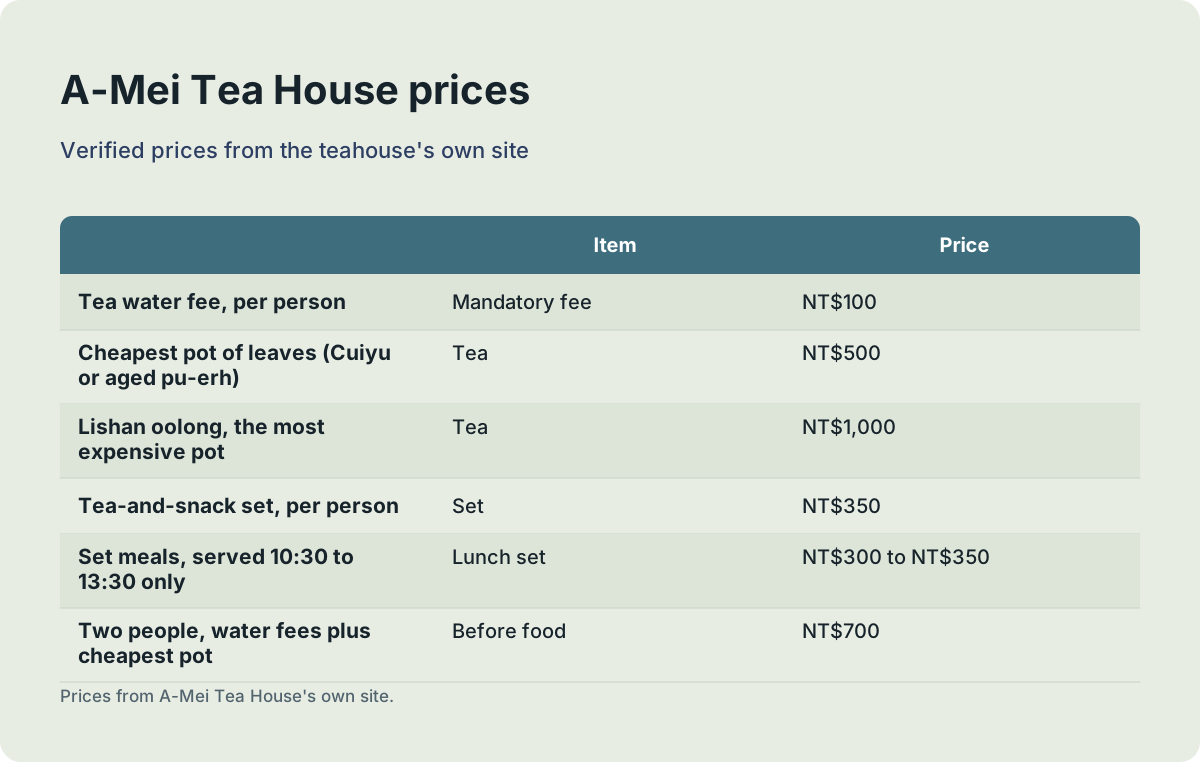
A-Mei Tea House is the most famous of the buildings on the stair lane, the multi-storey wooden structure that appears in half of all Jiufen photographs. It is also the only teahouse in Jiufen whose prices and hours are verified from its own site: open 09:00 to 21:30, seven days, with a tea water fee of NT$100 per person before anything else is ordered. The cheapest pot of leaves is NT$500. Two people sharing that cheapest pot therefore pay NT$100 + NT$100 + NT$500, or NT$700, before any food, which is the honest floor that most English pages miss by quoting only the water fee. The set meals run NT$300 to NT$350 and are served 10:30 to 13:30 only, and parties of six or more must order two portions of leaves. The menu and hours are on A-Mei Tea House's own site.
| Item at A-Mei Tea House | Price |
|---|---|
| Tea water fee, per person | NT$100 |
| Cheapest pot of leaves (Cuiyu or aged pu-erh) | NT$500 |
| Lishan oolong, the most expensive pot | NT$1,000 |
| Tea-and-snack set, per person | NT$350 |
| Set meals, served 10:30 to 13:30 only | NT$300 to NT$350 |
| Two people, water fees plus cheapest pot | NT$700 before food |
One thing to be careful about on Shuqi Road: no teahouse here is "the Spirited Away teahouse". A-Mei markets on the association, but marketing is not provenance, and Studio Ghibli has denied the connection on the record. More on that below.
What Is Qingbian Road, The Flat Lane Nobody Photographs?
Qingbian Road is the quiet, flat lane parallel to Jishan Street, and it is flat for a reason recorded by the city: it is the surviving level trackbed of a human-powered light railway laid in 1931 by the Ruifang Light Railway Company, founded by Yan Guonian. It moved people and supplies from Ruifang up to Jiufen and Jinguashi, and its roadbed is why the town has a flat route at all.
This is the single best piece of information in the 2016 release, and almost no English page carries it. The Jinguashi section of the line survives only in fragments, but the Jiufen section still has its original level roadbed. That is why Qingbian Road is flat while Shuqi Road, a few metres away, is a staircase: one was engineered as a railway, the other was a path down a slope. The line also connected to the Keelung light railway's Sanzhuazi line, so this little lane was once part of a working industrial network that served both mining towns.
For a visitor, Qingbian Road is the escape valve. When Jishan Street is at its heaviest, the flat lane a street over is noticeably calmer, and it gives the same hillside views without the queue. It is also the honest answer to the accessibility question: no official accessibility guidance, accessible route or lift exists for Jiufen in any source this site could verify, and inventing one would be a fabrication. What can be said, and is sourced, is that a level route through the town exists because it used to be a railway, while the street named for its vertical steps is exactly what its name says.
| Street | What the name means | What it is | Why it is that shape |
|---|---|---|---|
| Jishan Street | The street that connects to the foot of Keelung Mountain | Covered food alley, the main lane | Grew along the contour as the mining town's commercial street |
| Shuqi Road | The road of many vertical steps | Stone stair lane with teahouses | A path cut straight down the slope |
| Qingbian Road | The light railway lane | Quiet flat lane parallel to Jishan Street | Trackbed of a human-powered light railway laid in 1931 |
What Time Does Jiufen Old Street Open, And When Is It Crowded?
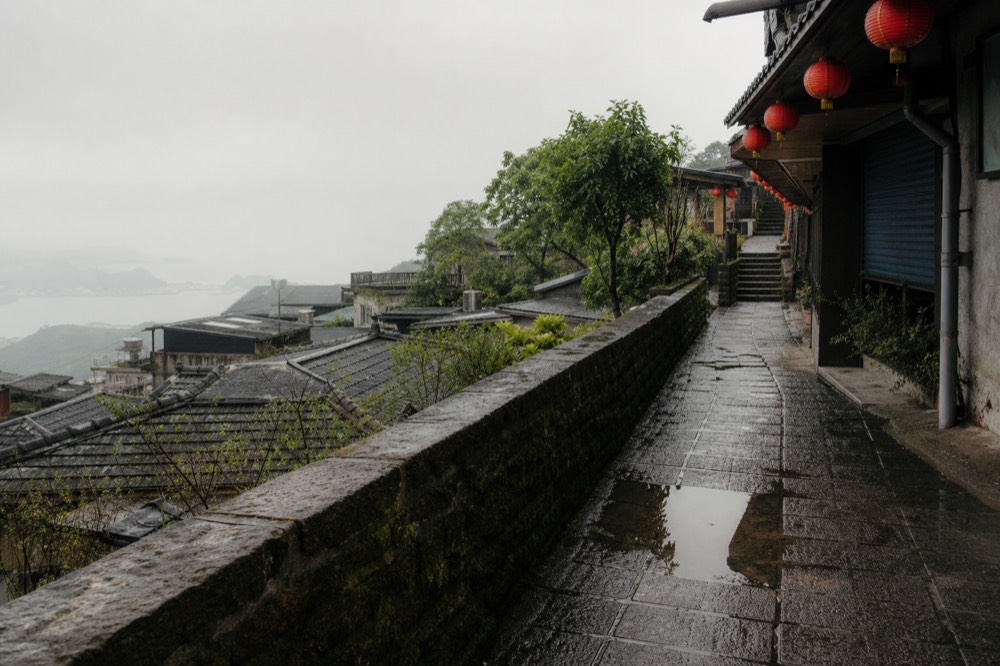
No official body publishes opening hours for Jiufen Old Street or its shops, so the honest answer is what visitors consistently report: most shops run roughly 10:00 to 19:00, teahouses stay open later, the heaviest crowding falls 10:00 to 17:00 on weekends and holidays, and the street is calm before about 09:00 and after about 19:00. Treat those as the reported pattern, not official times.
The one hard, official fact about crowding is not about the street at all but about the road to it. New Taipei City Government notice 新北府交規字第1132450546號, dated 10 December 2024 and in force from 1 January 2025, amends the Ruifang, Jinguashi and Jiufen Area Holiday Traffic Control Plan. On every weekend, national holiday, Labour Day and make-up working day, control hours run 08:00 to 20:00 across 3 A-grade and 6 double-A control points. Coaches must apply in advance to Ruifang Police Precinct, may not drive to Jiufen Old Street on their own, and are rationed to roughly 20 approved coaches per half-day slot, about 40 a day. Applications are refused entirely during holiday runs of three or more consecutive days.
Read that plainly: on any weekend or public holiday between 08:00 and 20:00, Jiufen is a managed-access destination, and coach access is switched off completely on long weekends. The plan restricts coaches, not private cars, and never pedestrians, but it is a real argument for arriving by train and bus, and a real argument for going on a weekday. The signed notice is published as a PDF of the traffic control notice if you want the primary document.
| Day type | What applies on the road up | What the street itself feels like |
|---|---|---|
| Weekday | No holiday control plan in force | Calmest conditions visitors report |
| Weekend or single holiday | Control 08:00 to 20:00, coach slots rationed to roughly 40 a day | Heaviest crowding 10:00 to 17:00 |
| Holiday of 3+ consecutive days | Coach applications refused entirely | Peak crowding, coach passengers transfer to a shuttle |
| Early morning or after 19:00 | Control hours may still apply on holidays | The calm window visitors consistently describe |
For a deeper look at the timing question, including the day-versus-night trade-off, see is Jiufen better during the day or at night.
What Is Left Of The Mines Under The Old Street?
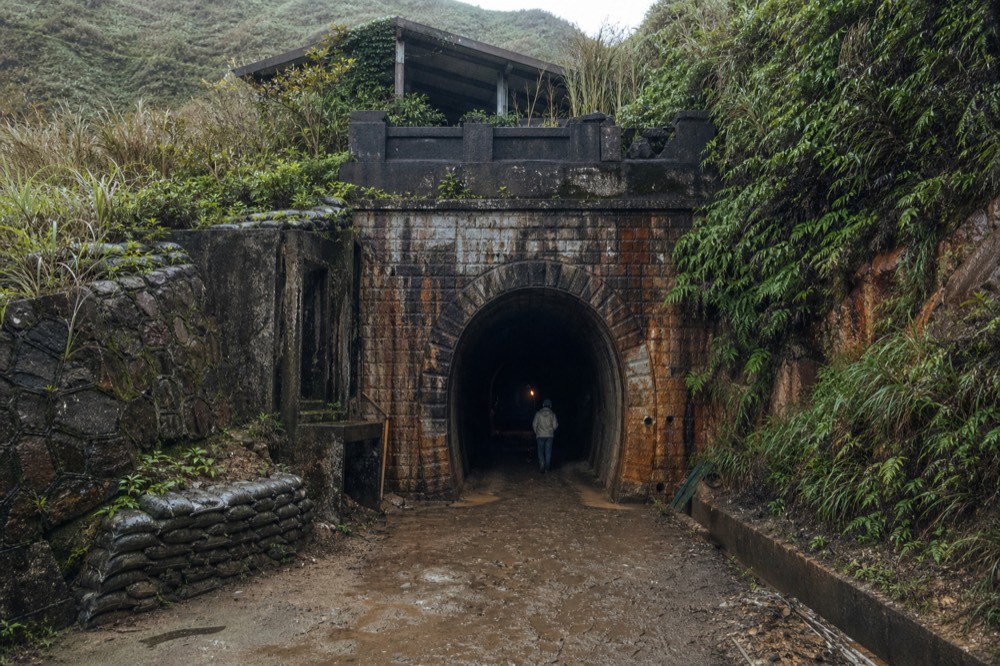
Ten numbered mine tunnels once ran down this hill, and the 2016 city release records their fate: Nos. 1 to 4 are gone to open-cast working or collapse, and only Nos. 5, 8 and 10, the Wufan, Bafan and Shifan pits, still have intact portal exteriors. Two local bus stops, Liu Hao Bridge and Qifan Pit, still carry the old pit names in theirs.
The portals are the physical remains of the town's reason to exist, and they sit in and around the streets themselves, not in a separate museum site. The 1890 strike near Jiufen that drew 4,000 families of prospectors is the Tourism Administration's own account, and the tunnels down the hillside are what that rush eventually built. The bus stop named Qifan Pit, Seventh Pit, still carries its mining name on the sign even though Liu Hao Bridge has since been renamed Jinshi Bridge, a small piece of the town's memory preserved by inertia.
For the fuller mining story, including the Gold Museum at Jinguashi, admission NT$80, closed the first Monday of every month, see Jinguashi and the Golden Waterfall. The cheapest ticket on this site's roster, the Gold Museum e-ticket from $2.55 per person, is redeemed there, not in Jiufen, and nothing in the Jiufen Tickets and Experiences category is boarded in Taipei.
| Pit number | Status today |
|---|---|
| Nos. 1 to 4 | Gone, to open-cast working or collapse |
| No. 5, Wufan Pit | Intact portal exterior |
| No. 8, Bafan Pit | Intact portal exterior |
| No. 10, Shifan Pit | Intact portal exterior |
| Nos. 6, 7, 9 | Not recorded as intact in the city release |
Is Jiufen Old Street The Spirited Away Town?
No, and Studio Ghibli has denied it on the record. On 19 September 2023, producer Toshio Suzuki, interviewed in Tokyo by Taiwanese media, said of the claim: "That's not true. Neither I nor Miyazaki has ever been to Jiufen." He attributed the moment of resemblance Miyazaki actually had to an alley in Seoul, and Taiwanese media framed the denial as ending a 22-year misunderstanding.
Three outlets, ETtoday, Mirror Media and FTNN, published the same quotes the same day. Suzuki added that the rumour does not trouble him, because it means people care about the work, which is a generous reading of a story that has filled Jiufen's lanes for two decades. Mirror Media's report also names Dōgo Onsen Honkan in Matsuyama as a real reference location for the film, reported, not Ghibli-confirmed.
What remains true, and worth saying plainly: the resemblance a visitor sees standing on Shuqi Road at dusk is real. Red lanterns, wooden balconies, stairs tumbling down a hillside toward the sea, it genuinely looks like the film's world. Only the causal claim is false. Jiufen did not inspire Spirited Away, no teahouse here is "the Spirited Away teahouse", and any page that tells you otherwise without carrying the denial is repeating a rumour the studio itself has killed. The full story, including the Seoul quote in Suzuki's own words, is in Jiufen and Spirited Away.
| Claim | What the record says |
|---|---|
| Jiufen inspired the film | Denied on the record by producer Toshio Suzuki, 19 September 2023 |
| Miyazaki visited Jiufen | Suzuki: neither he nor Miyazaki has ever been to Jiufen |
| The moment of resemblance | Suzuki attributes it to an alley in Seoul, on a walk the two took in Korea |
| A "Spirited Away teahouse" | No teahouse holds that status; A-Mei's marketing is not provenance |
| Dōgo Onsen as a reference | Reported by Mirror Media as a reference location, not Ghibli-confirmed |
How Do You Get To Jiufen Old Street From Taipei?
By train to Ruifang, then bus or taxi up the hill, or by a direct bus: Taipei Main Station to Ruifang runs 45 to 47 direct trains a day, 32 to 68 minutes, from NT$73 on a Local. There is no direct train from Taipei to Shifen, you change at Ruifang, and Keelung Bus 1062 runs from Taipei toward Jinguashi via Jiufen.
The rail numbers are the strongest verified transport figures on this site, straight from Taiwan Railway Corporation's own fare tables effective 8 May 2025 and its live booking system. The Local and Fast Local cost NT$73, Chu-Kuang NT$87, Tze-Chiang and Puyuma NT$114. The fastest service found, Puyuma 228, covers the run in 33 minutes; the slowest Local takes 68. The express saves about 13 minutes over the median local and costs NT$41 more, so the local train is the sensible default on this route.
The bus alternative exists and is registered with the Ministry of Transportation and Communications Highway Bureau as route 1062, Taipei City via the Sun Yat-sen Freeway to Ruifang District and Jinguashi, operated by Keelung Bus. What no verified source publishes is its fare, its departure exit at Zhongxiao Fuxing MRT, its headway or its journey time; every figure circulating for those traces back to blogs and aggregators, so this page prints none of them. The full transport breakdown, including the local routes 788, 827 and 825 from the New Taipei open-data dataset, is in Taipei to Jiufen.
| Train class, Taipei Main to Ruifang | Full fare | Concession | Notes |
|---|---|---|---|
| Local and Fast Local | NT$73 | NT$37 | The sensible default |
| Chu-Kuang | NT$87 | NT$44 | |
| Tze-Chiang and Puyuma | NT$114 | NT$57 | Saves about 13 minutes over the median local |
Remember the traffic control plan above when you choose your day: on weekends and holidays the coach fleet is rationed, and on long weekends it is barred entirely, which pushes more of the arrival load onto the train and the local buses. A weekday visit avoids the whole mechanism.
How Long Should You Spend, And What Else Is Nearby?
How long a visit takes is not published by any official source, so this page prints no figure for it. What is verifiable is the surrounding circuit: Shifen and its sky lanterns sit on the Pingxi branch line, 17 direct trains a day from Ruifang at a flat NT$29, and Yehliu Geopark lies the other way along the coast, adult ticket NT$120.
Houtong Cat Village is 44 services and NT$22 from Ruifang. Most visitors fold Jiufen into a day that also takes in Shifen, and the pairing works because the branch line starts at Ruifang, the same station you change at coming from Taipei. Note the branch timetable's gaps: roughly hourly through the middle of the day, then a 1h39m gap after the 16:54 departure and a 1h44m gap after 19:22, and the same 17 trains run on a Saturday as on a Monday, because the line gets no extra weekend capacity.
The lantern law matters here too: releasing a sky lantern is banned everywhere in New Taipei City except one marked stretch of Pingxi, from the Shifen Visitor Center to Shigong Bridge within 200 m of the Keelung River along County Road 106. The statutory text is at the New Taipei City laws database.
If you are planning the full circuit rather than the town alone, the practical pages are Jiufen and Shifen in one day, Shifen Old Street and sky lanterns and Yehliu Geopark. For the town's evening character, when the lanterns come on and the day-trippers have gone, see Jiufen at night.
The three-street frame is the simplest way to plan your hours on the ground. Walk Jishan Street early while the shops are opening, take Shuqi Road down for the teahouse and the view, and use Qingbian Road, the old railway, as your calm route back. That is the whole town, and it is the shape it is because of camphor stoves, a gold strike, and a light railway that no longer runs.
These are the questions visitors ask most about Jiufen Old Street, answered with the same standard used throughout this guide: official figures where they exist, the consistently reported pattern where they do not, and no invented numbers anywhere. Each answer below states its source basis plainly.
Common Questions About Jiufen Old Street
What time does Jiufen Old Street open?
No official body publishes opening hours for the street or its shops. Visitors consistently report most shops running roughly 10:00 to 19:00, with teahouses open later, and the street calm before about 09:00 and after about 19:00. Treat those as the reported pattern, not official times.
Is Jiufen Old Street one street or three?
Three. Jishan Street is the covered food alley, Shuqi Road is the stair lane whose name means "the road of many vertical steps", and Qingbian Road is the flat lane that was the trackbed of a 1931 human-powered light railway. The names and origins are in a New Taipei City Government release of 6 January 2016.
Is Jiufen Old Street the Spirited Away town?
No. Studio Ghibli producer Toshio Suzuki denied it on 19 September 2023, saying neither he nor Miyazaki has ever been to Jiufen, and attributing the moment of resemblance to an alley in Seoul. The visual resemblance is real; the causal claim is false.
Where does the name Jiufen come from?
The city officially calls the nine-families story a legend. Scholarly research and the Taiwan Tourism Administration both give the camphor origin: 90 camphor stoves before the gold rush, ten stoves to a unit, nine units, nine "fen".
Is there an entrance fee for Jiufen Old Street?
No, the street itself is free to walk. Paid items are individual: teahouses, food, and the Gold Museum at Jinguashi if you continue there, admission NT$80.
What is the least crowded time to visit?
Weekdays, and on any day before about 09:00 or after about 19:00, which is the calm window visitors consistently report. On weekends and holidays the traffic control plan also rations coach access between 08:00 and 20:00, which concentrates arrivals.